
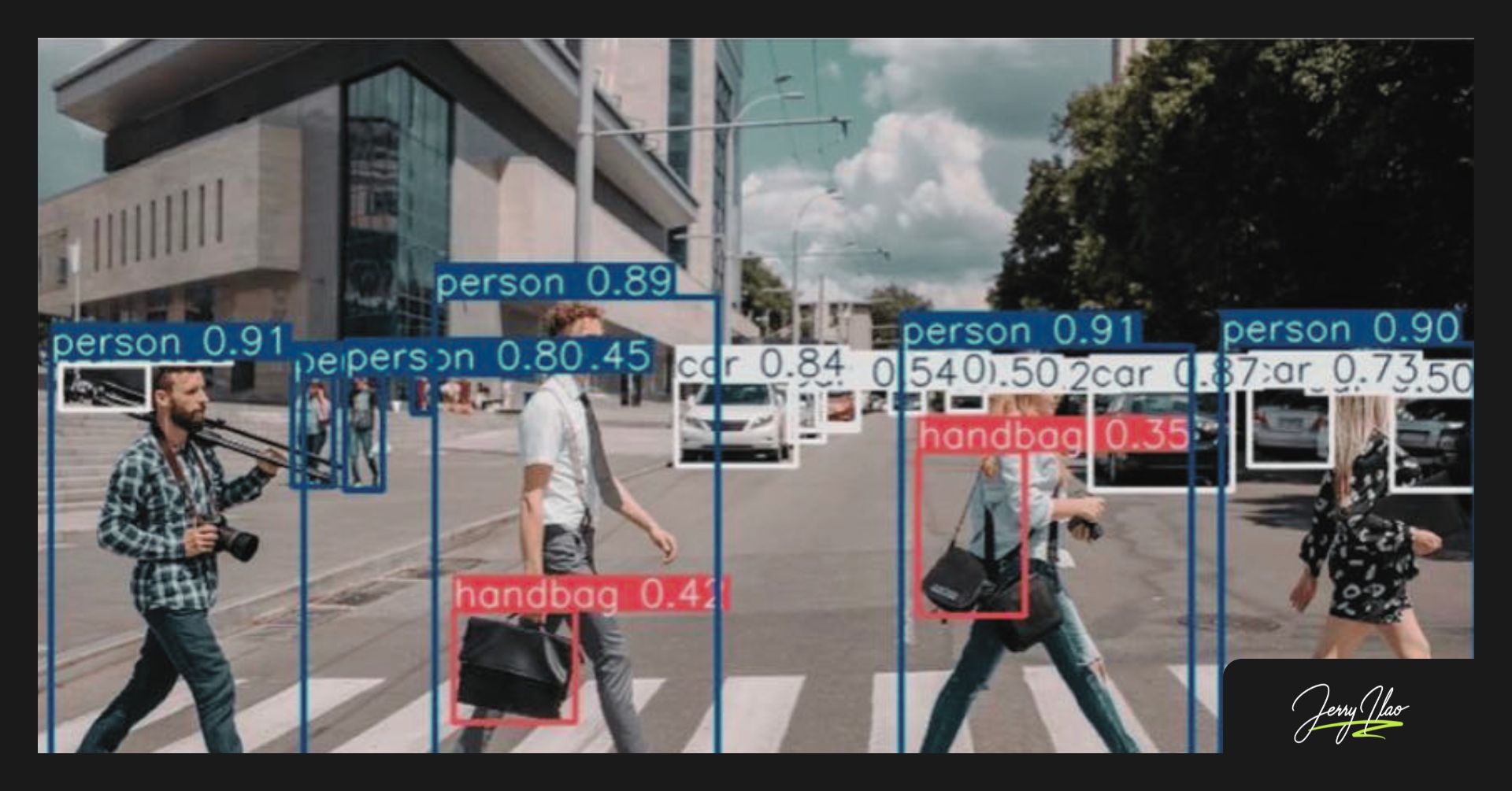

YOLO stands for You Only Look Once, a real-time object detection model first published in 2015 by Joseph Redmon, Santosh Divvala, Ross Girshick, and Ali Farhadi at the University of Washington. It processes a full image in a single neural network pass at 45 frames per second, enabling instant identification of objects. Business leaders encounter YOLO object detection in self-driving vehicles, security cameras, face detection, logistics, and manufacturing quality control.
Millennials popularized it: YOLO. You Only Live Once.
It became a mantra for living boldly, taking risks, and saying yes to life. Trips were booked on a Thursday. Decisions that probably needed a second look were made before anyone slept on them.
But in the world of AI, YOLO means something entirely different.
It stands for You Only Look Once, and it is one of the most consequential object detection models in computer vision. Understanding how it works, and where it is already running quietly in the background of daily life, gives business leaders a useful mental model for thinking about how AI makes decisions at speed.
The problem YOLO was built to solve
Before YOLO, object detection systems worked in two stages. First, a model would scan an image and propose candidate regions that might contain objects. Then it would classify each region in a separate pass. The result was accurate but slow. Fast R-CNN, one of the leading systems at the time, took 2 to 3 seconds to process a single image.
That is fast for most purposes. It is nowhere near fast enough for a car traveling at 60 kilometers per hour that needs to decide whether an object on the road is a traffic cone or a child.
Joseph Redmon, Santosh Divvala, Ross Girshick, and Ali Farhadi at the University of Washington published their solution in 2015. Instead of two passes, YOLO treats the entire detection problem as a single regression. One forward pass through a deep convolutional neural network. Bounding boxes and class probabilities predicted simultaneously across the whole image.
The base YOLO model processes images in real time at 45 frames per second. A faster variant called Fast YOLO runs at 155 frames per second with slightly lower accuracy. The original paper’s title says it plainly: You Only Look Once — Unified, Real-Time Object Detection.
That name is not just marketing. It describes the architecture.
Where YOLO object detection is already running
YOLO is not a research curiosity. It is embedded in production systems most people interact with regularly.
Self-driving vehicles. Autonomous vehicle platforms use YOLO and its successors to recognize pedestrians, road markings, other cars, traffic signals, and unexpected obstacles in real time. The single-pass design is what makes this viable. A two-pass system at 2 seconds per frame would be unusable on a road.
Security and surveillance. Security camera networks use object detection to flag unusual movement, identify unattended objects, and count people in restricted areas. The review literature on YOLO applications consistently identifies surveillance and traffic safety as two of its highest-impact deployment domains.
Consumer device cameras. Face detection in smartphone cameras, scene recognition in photo apps, and real-time subject tracking in video recording all draw on object detection architectures related to or descended from the original YOLO approach.
Logistics and manufacturing. Distribution warehouses use object detection to track parcels on conveyor systems, verify labels, and flag damaged packaging. Manufacturing lines use it for quality control. In both contexts, the speed-and-accuracy tradeoff YOLO makes — prioritize throughput, accept some precision loss on overlapping or very small objects — aligns with what the application actually needs.
Agriculture and healthcare imaging. Research reviews document YOLO deployments for crop surveillance, disease detection in field images, and anomaly detection in medical scans. The model’s versatility comes from the same property that makes it fast: it looks at the whole image at once rather than inspecting each region separately.
Since the original 2015 release, the YOLO family has expanded substantially. YOLOv2 and YOLOv3 were published by Redmon himself. Subsequent versions, including YOLOv4 through YOLOv13, YOLO-NAS from Deci AI, and YOLO-World from Tencent’s AI Lab, have been developed by other teams building on the original architecture. Each release has worked to close the precision gaps while preserving the speed that made YOLO worth building on.
What the single-pass design tells us about AI decision-making
There is a common mental model of AI as a system that thinks carefully before acting. That image comes partly from large language models, where deliberate, multi-step reasoning is built into how the output gets produced. Slow, thorough, considered.
YOLO sits at the other end of the design spectrum entirely. It is built around one constraint: make a correct decision before the moment passes. No iteration. No second look. No checking your work.
The tradeoff is real. YOLO can lose accuracy on very small objects or on scenes where objects overlap heavily. The history of YOLO improvements is largely a history of closing that gap without sacrificing the speed advantage. But the core design decision has remained consistent across a decade of versions: one pass, one answer, move on.
That is a genuine engineering choice, not a limitation waiting to be fixed. For the applications YOLO targets, a perfect answer 0.3 seconds later is worse than a good-enough answer now.
This tension between speed and thoroughness is not unique to computer vision. It shows up in every AI deployment decision a business leader makes.
Three ways to apply the YOLO principle in your AI strategy
The single-pass design principle maps directly onto decisions most teams face when deploying AI. Here is how to use it.
Match the model to the decision speed the task actually requires. Not every AI use case needs a heavy reasoning model. Fraud detection at the point of sale, real-time customer routing, and inventory reorder triggers all benefit from speed over deliberation. If your team is running a large language model on a task that needs a millisecond decision, you are using a two-pass system where YOLO thinking applies. Audit the decision types in your current AI implementations and ask which ones are bottlenecked by model latency rather than model quality.
Fix the input before you change the model. YOLO works in production because the images it receives are preprocessed consistently: resized to a standard format, padded to preserve aspect ratio, passed through a standardized pipeline. When YOLO fails, it often fails because the input was unusual, not because the model was wrong. This principle transfers directly. In workshops run through PAIBA, the most common reason AI tools underperform is inconsistent input — prompts that vary widely, documents formatted differently each time, data passed to the model without standardization. Before replacing the model, examine the pipeline feeding it.
Build in friction deliberately for decisions that need it. YOLO is extraordinary in its domain and wrong for decisions where a second pass prevents serious harm. A self-driving car needs single-pass speed on object detection. A compliance decision about a large customer contract does not. Business leaders who apply AI well know which decisions benefit from the YOLO constraint and which ones require a slower, more deliberate system with checkpoints. The skill is not defaulting to speed everywhere. It is designing the right friction level into the right decision point.
Where to start this week
Pick one AI-assisted decision process your team currently runs and ask two questions: How fast does this decision actually need to be made? And what would a one-pass version of this process look like?
If the answer reveals your team is slowing down a fast-decision process with unnecessary deliberation steps, simplify the pipeline. If it reveals a fast-decision process that should have more checkpoints, add them. Either direction is useful. The YOLO principle is a diagnostic tool as much as it is a deployment model.
Frequently Asked Questions
What does YOLO stand for in AI? In artificial intelligence, YOLO stands for You Only Look Once. It is a real-time object detection algorithm first published in 2015 by Joseph Redmon, Santosh Divvala, Ross Girshick, and Ali Farhadi at the University of Washington. The name describes its core architecture: the model processes an entire image in a single neural network pass rather than in multiple stages.
How fast is YOLO object detection? The original YOLO model processes images in real time at 45 frames per second. A faster variant, Fast YOLO, runs at 155 frames per second with a modest reduction in accuracy. Subsequent versions in the YOLO family, including YOLO-NAS and YOLO-World, have continued to improve the speed-accuracy tradeoff with each release.
What are the main applications of YOLO object detection? YOLO is used in self-driving vehicle systems for real-time object identification, security and surveillance cameras for movement and anomaly detection, smartphone face detection, manufacturing quality control, logistics parcel tracking, agricultural crop monitoring, and medical imaging anomaly detection. Its single-pass design makes it practical for any application where detection speed is more important than exhaustive accuracy.
How is YOLO different from other object detection models? Earlier object detection models like Fast R-CNN used a two-stage pipeline: first proposing candidate regions, then classifying each region separately. This produced accurate results but took 2 to 3 seconds per image. YOLO collapses both stages into a single neural network pass, predicting bounding boxes and class probabilities simultaneously across the entire image, which enables its real-time performance.
Why does YOLO sometimes miss small objects? YOLO divides images into a grid and predicts objects within each grid cell. This approach is fast but can struggle when multiple small objects appear in the same grid cell or when objects are very small relative to the image. Each version of YOLO released since 2015 has worked to reduce this limitation while preserving single-pass speed.
What does YOLO mean for business leaders thinking about AI? YOLO object detection illustrates a fundamental AI design tradeoff: speed versus thoroughness. Business leaders can use this as a mental model when deploying AI. Some decisions need single-pass speed and a good-enough answer immediately. Others need a slower, multi-step process with checkpoints. Identifying which type of decision each AI use case involves is a practical first step toward building the right system for the right context.