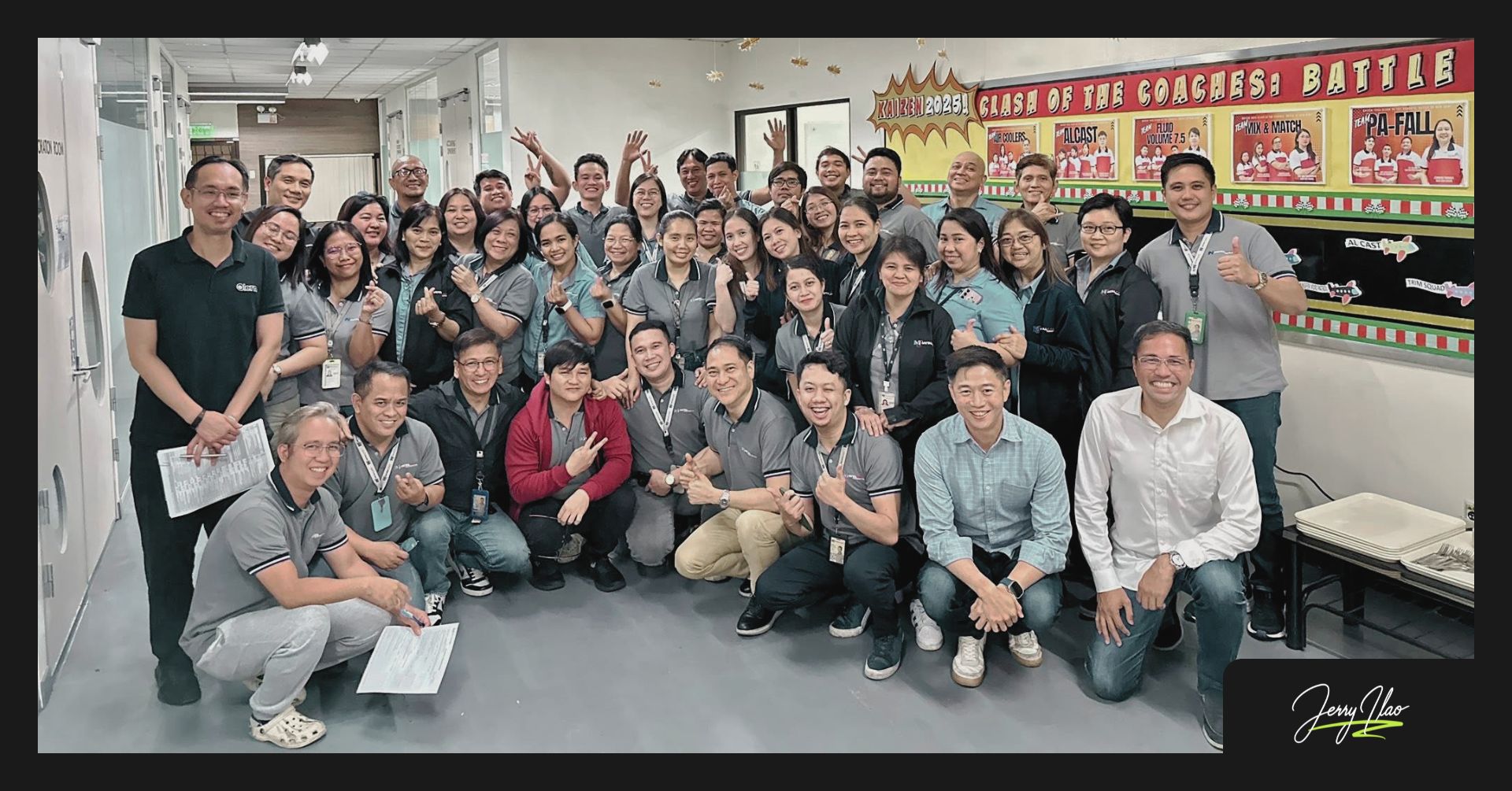

I had the privilege of training the engineers, process owners, and managers of Metalcast Corporation on how to apply AI to improve their operations. Metalcast is a precision die-casting manufacturer in Carmona, Cavite, producing automotive, motorcycle, and OEM components. It is the kind of plant where one recurring reject or an hour of unplanned downtime carries a real cost. That setting kept the whole session honest.
Most AI training stops at concepts. People leave able to explain what a model is, maybe impressed by a clever demo, and then Monday arrives and nothing on the production floor has changed. And honestly, that is understandable. Concepts are easier to teach than change, and a demo is easier to deliver than a result. But a session that ends in admiration instead of action gets forgotten by the end of the week.
So we ran it differently.
Why most AI for manufacturing stalls before the floor
There is no shortage of AI in manufacturing conversations right now. Vendors pitch predictive maintenance. Conference talks promise smart factories. The tools are real and many of them work. So why does so much of it stall before it reaches the people doing the work?
The bottleneck is rarely the tool. It is the gap between a capability and a decision. A factory can buy access to powerful AI and still change nothing, because nobody on the floor connected that capability to a problem they actually own. The model sits in a tab. The license renews. The reject rate stays the same.
You have seen this happen with new equipment before, haven’t you? The machine that solves a real bottleneck gets adopted within a week. The one bought because it looked impressive at a trade show gathers dust in the corner. AI behaves the same way. It gets used when it earns its place against a problem people care about, and it gets ignored when it does not.
That is why the order of a training session matters more than the tool you bring into it.
We started with their problems, not the tool
Before anyone touched AI, each department named its most critical operational challenges. Production downtime. Rejects. Quality inspection. Production blockers. None of these were hypothetical case studies pulled from a textbook. They were the exact issues already sitting in their tracking sheets and shift logs, the ones that surface in every production meeting and never quite get solved.
That sequence changes everything. When you lead with the tool, people go looking for a problem that fits the demo, and they usually pick a small one so the demo looks clean. When you lead with the problem, the tool has to earn its place against something that genuinely costs the business money, time, or risk. The first approach produces a tidy proof of concept. The second produces a reason to keep going on Monday.
It also changes who feels ownership. A solution handed down from a vendor belongs to the vendor. A solution a team built around its own reject log belongs to the team. People defend what they helped build.
What AI for manufacturing actually looked like on the floor
Once the problems were on the table, we brought AI into the room as a thinking partner, not a magic answer. Each team took its own logs and tracking data as raw material and used AI to brainstorm and design practical solutions around them.
This is the part that separates AI for manufacturing from AI in a slide deck. The people closest to the work were the ones prompting, questioning, and refining. A process owner who has watched the same reject appear for two years asks sharper questions than any outside consultant, because she already knows where the data lies and where it tells the truth. AI gave her a faster way to test ideas against information she already trusted, and to do it in an afternoon instead of over weeks of back-and-forth with people who have never stood at her station.
Consider what this looks like in practice. A quality inspector pulls the last few months of reject records and asks AI to help spot which defect types cluster around which shifts, which materials, or which machines. The AI does not deliver a verdict. It offers patterns worth checking, and the inspector, who knows the floor, decides which ones are real and which are noise. A maintenance lead takes the downtime log and works through what an early-warning routine might look like, framed entirely around the failures her plant actually has, not the generic ones in a brochure.
Nobody was waiting for a software vendor to deliver a roadmap. The roadmap came from the floor.
The teams left with strategies, not slogans
By the end of the session, every team presented a concrete strategy. Cut costs. Reduce rework. Improve scrap monitoring. Elevate safety performance. Each one was powered by AI, and each one pointed back to a number someone on that team already tracked.
The value was not the polish of the output. What mattered was that each strategy tied back to something measurable. A plan to reduce rework means little until it is anchored to last month’s reject rate. A safety improvement is just a poster on the wall until it connects to the actual incidents in the logbook. Tying AI to numbers people already own is what turns a good idea into a decision someone is willing to act on, and then to defend when the next production meeting asks whether it worked.
This is also where responsible use enters quietly. None of these teams handed a decision to the AI. They used it to think faster, then applied their own judgment to what it produced. The inspector still signs off on the defect analysis. The maintenance lead still decides what to act on. AI widened the set of options. People still chose among them. That is the version of AI adoption that holds up over time, because it keeps the people who own the outcome in control of the call.
How to run AI for manufacturing in your own operation
If you want AI to land on your floor instead of in a folder of meeting notes, the method matters more than the model. Here is how to set it up.
Start with your most expensive problem, not the most exciting tool. Ask each team to name the issue that costs the most in money, time, or risk. Write it on the board before any software is opened. Let that problem, not the demo, set the agenda for the whole session. A team that spends the first hour naming what actually hurts will spend the rest of the day on something worth solving.
Bring the logs you already keep. Pull the tracking sheets, shift reports, reject records, and downtime logs into the room. AI does its best work on data your people already trust, because they can immediately tell when an answer does not match reality. Generic data produces generic ideas. Your own data produces ideas your team can act on tomorrow.
Put the AI in front of the department, not the consultant. Let the process owners and line managers do the prompting themselves. The person who lives with the problem will push the tool harder, ask the follow-up questions an outsider would not think of, and catch the gaps a polished demo would hide. Skill on the floor compounds. Skill rented from outside leaves when the contract ends.
End every session with a strategy someone can act on Monday. Do not close on a concept or a list of interesting possibilities. Close on a specific plan, tied to a specific number, with one named person who owns the next step. The difference between a workshop people remember and one they forget is whether anyone had something concrete to do the next morning.
When AI becomes part of the work
None of this required a new platform or a big budget. It required leaders willing to put real problems in front of their people and give them room to think alongside a new tool. The setup was small. The effect was not. AI stopped being a topic for the conference room and started being a method on the production floor.
That is the whole shift, and it is the real competitive question for manufacturers right now. Tools are everywhere, and they get cheaper every month. The advantage no longer comes from having access to AI. It comes from how quickly your people learn to use it on the work in front of them. A plant where every department knows how to point AI at its own logs will outpace a plant that bought the better software and never changed how anyone works.
This is what transformation looks like: when AI moves from theory to daily decision-making.
Frequently asked questions
How can AI be used in manufacturing operations?
AI is most useful in manufacturing when it is applied to specific, measurable problems a team already tracks, such as reducing rejects, monitoring scrap, predicting downtime, or improving quality inspection. Teams use their own production logs and tracking sheets as input, then use AI to spot patterns and design practical solutions. The people who own the process make the final decisions, with AI accelerating the thinking rather than replacing the judgment.
Why do AI projects fail in manufacturing?
Most AI projects in manufacturing fail not because the tool is weak, but because the capability was never connected to a problem the team actually owns. When AI is introduced as a demo or a vendor pitch rather than tied to a costly, measurable issue, it sits unused. Starting with the most expensive operational problem, instead of the most impressive tool, is what keeps a project alive past the first week.
What data do you need to apply AI in manufacturing?
You can start with the operational data you already keep: reject records, downtime logs, quality inspection sheets, scrap monitoring data, and shift reports. AI works best on data your people already trust, because they can tell immediately when an output does not match what happens on the floor. You do not need a new data system to begin, only the records you already maintain.
Do you need a big budget to use AI for manufacturing?
No. A practical AI for manufacturing session needs leaders willing to put real problems in front of their people, the operational logs the team already keeps, and access to a general AI tool. The value comes from the method, not from an expensive new platform. Many useful first projects can be designed in a single hands-on workshop without any new software purchase.
How do you run an AI workshop for a manufacturing team?
Start by having each department name its most expensive operational problem before any tool is opened. Bring the team’s own tracking sheets and logs into the room, and let the process owners and line managers do the prompting themselves rather than an outside consultant. End the session with a concrete strategy tied to a number the team tracks, with one named owner for the next step.