
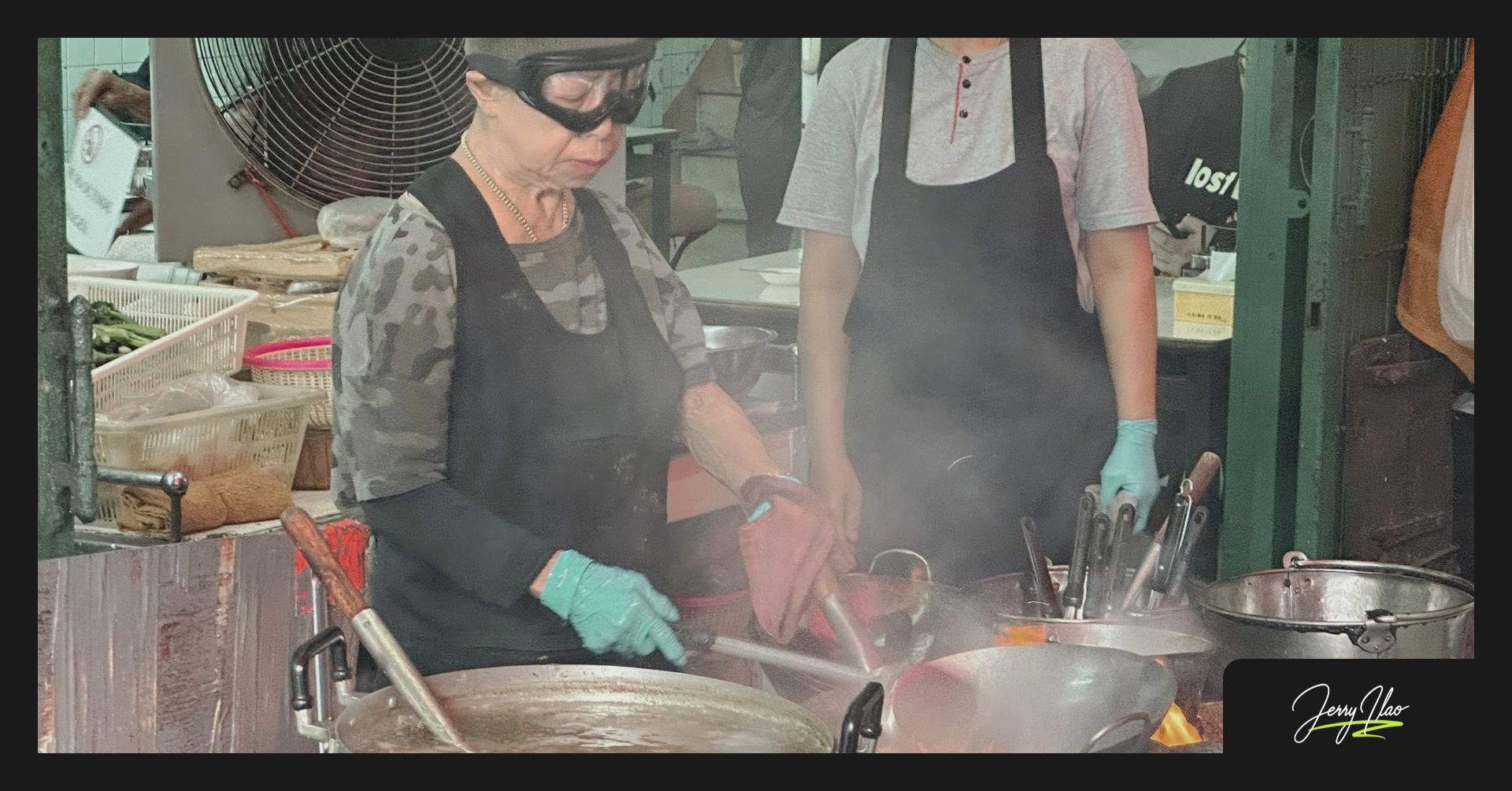

I finally experienced the famous dishes of Jay Fai in Bangkok.
I first watched her on Netflix’s Street Food years ago, and I had wanted to eat there ever since. Last week I finally made it. Jay Fai, whose real name is Supinya Junsuta, is a Michelin-starred chef and the first and only street-food cook in Thailand to hold a star. She has kept it since the very first Bangkok Michelin Guide, awarded for the 2018 edition. Her stall on Maha Chai Road has no air-conditioning and no white tablecloths. It has a charcoal wok, plastic stools, and a queue that runs for hours.
The meal was excellent. But what stayed with me was not the food. It was the business lessons she demonstrated, without saying a single word, for almost two hours straight.
Commitment to the craft
We were there for close to two hours, and she cooked non-stop the entire time.
Now in her late 70s, she is still on the line. Still at the wok. Still sourcing and inspecting her own ingredients every morning before service. Most people her age have long since stepped back. She has not. She has cooked on roughly the same spot since the 1960s, taking over a noodle stall and turning it, over decades, into one of the most talked-about kitchens in the world.
Many of us in business work differently. We get bored after a few years and chase something new. A new model, a new market, a new idea. And that is understandable. New things are exciting, and novelty feels like progress.
But watching Jay Fai reminded me of something simple. Excellence is built over decades, not years. The person who does the same thing well, every day, for thirty years will almost always beat the person who does ten different things for three years each. The Michelin star did not change how she works. It just put a spotlight on a standard she had already been holding for a very long time.
There is no shortcut here. You show up daily, you do the grind, and you make no excuses. The craft rewards the people who stay. This is the part most business owners underestimate, because depth is slower and less visible than expansion. Nobody applauds you for getting quietly better at the same thing. The market eventually does.
What struck me most is that she has never tried to franchise the standard or hand it to someone else. She has said she has no plans to pass the restaurant on to her family, and she still does the hardest, least glamorous part herself: waking early to source and check produce before service, sending back anything that does not meet her bar. The fame, the Netflix episode, the celebrity guests, none of it pulled her off the line. For a business owner, that is the uncomfortable lesson. The standard is not something you set once and delegate. It is something the founder often has to keep carrying personally, far longer than is convenient.
Process is power
What amazed me most was not her skill. It was her system.
She insists on cooking every dish herself. There were around three people assisting her, but she does all the actual cooking. And yet the throughput stays high, because the process around her is tight. As soon as a dish is done, a staff member swaps the wok so she never waits for a clean pan. The ingredients are already prepped, portioned, and within reach. Her famous crab omelette, the dish most people line up for, comes out one after another without any visible drop in pace. Nothing breaks her rhythm.
In the two hours we were there, she likely cooked more than fifty servings. That is my own rough count, not an official figure, but the volume was striking. One person. One pair of hands. Fifty-plus plates, each at the same standard that earned the star.
That is what great systems do. They protect quality and hold speed at the same time. The system is not there to slow her down. It is there to let her do the one thing only she can do, as many times as possible, without dropping the standard. Everyone around her exists to remove friction from her hands, not to add steps to her work.
You want quality and speed at once, right? Most business owners do. The problem is that many of us build the opposite. I see businesses with broken processes that delay every action, where a simple approval bounces between three people for a week. And I see the other failure too. Businesses that add complicated workflows, extra sign-offs, and layers of review that slow down decisions, and then defend the slowness in the name of process compliance.
A good process removes friction from the work that matters. A bad process adds friction and calls it control. The test is simple. Does the process help your best people do their best work faster, or does it mostly exist to make everyone feel safe? Jay Fai’s stall is a master class in the first kind. Every part of her setup is designed around one question: how do we let her cook more, better, without making her stop?
Google reviews for business are only part of the story
Here is something I almost got wrong.
We nearly did not go because of the bad reviews. Rude staff. Unclean place. Slow service. The usual complaints. But we experienced none of that. The service was fine, the food was extraordinary, and the operation was tighter than most fine-dining kitchens I have seen. Maybe things have improved since those reviews were written, which would be a good thing.
Take the no-selfies policy. Some reviews complained about it. But she was cooking non-stop the entire time. If she stopped to pose for a photo with everyone who asked, serving times would collapse and the people already waiting in line for hours would wait even longer. Once you watch the kitchen for yourself, the policy is not rude. It is the only way the system survives. Understandable, once you see it in context.
This is why I have been telling business owners the same thing for years. Getting reviews is something every business should do on purpose. In an age where online feedback decides whether a customer walks in or walks away, you cannot leave your reputation to chance. Most satisfied customers say nothing. They enjoy the experience, they go home, and they move on. The unhappy ones, on the other hand, are highly motivated to post. So if you do not proactively ask your happy customers to leave a review, the public record of your business gets written almost entirely by your worst days. Or worse, by fake reviews from people who were never your customers at all.
The reviews are real data. But they are partial data. They over-represent the extremes and under-represent the quiet majority who simply had a good time. The full picture is the one you build by asking for it, consistently, as part of how you run the business.
Where to start this week
Three lessons are easy to nod at and hard to act on. So here is where I would start.
Pick one craft and go deeper instead of wider. Choose the one skill, product, or service your business is genuinely known for, and spend this quarter making it sharper rather than launching something new. Resist the urge to add a new offering until the core one is undeniably excellent.
Tighten one process that touches your best work. Find the single workflow that protects your quality, then remove one step that adds friction without adding value. Watch whether throughput improves. If nothing breaks, the step was control for its own sake, and you have just made your best people faster.
Ask three happy customers for a review this week. Not a campaign, not a discount-for-reviews scheme. Just three people who already love what you do. Make the ask a normal part of how you close out good work, and it stops feeling awkward fast.
The standard is the point
Jay Fai is not famous because she cooked one great dish. She is famous because she has cooked the fifty-thousandth crab omelette as carefully as the first.
That is the real lesson behind all three. Commitment keeps the standard high over decades. Process keeps the standard high under pressure. And honest feedback tells you whether the standard is actually being felt by the people you serve. Take any one of them away and the other two eventually slip.
So the question for any of us running a business is not whether we can be excellent once. It is whether we can be excellent at scale, on an ordinary Tuesday, when no one is filming and no guide inspector is watching.
Can you cook one great dish? Can you cook the fiftieth as well as the first? The honest answer to the second question is where most businesses are actually won or lost.
Frequently asked questions
Who is Jay Fai and why is she famous?
Jay Fai, whose real name is Supinya Junsuta, is a Bangkok street-food chef famous for her charcoal-wok cooking and her signature crab omelette. She is the first and only street-food cook in Thailand to hold a Michelin star, which her stall on Maha Chai Road has retained since the first Bangkok Michelin Guide. She also appeared in Netflix’s Street Food series.
How does Jay Fai cook so many dishes by herself?
She cooks every dish personally but works inside a tightly run system. A small team of about three assistants preps ingredients in advance and swaps her wok the moment a dish is done, so she never pauses to reset. The setup is built to remove friction from her hands, which lets her maintain both speed and quality.
Why are Google reviews for business only part of the story?
Online reviews tend to over-represent unhappy customers, because dissatisfied people are far more motivated to post than satisfied ones. They can also include fake or outdated entries. Reviews are useful data, but they show the extremes rather than the typical experience, so a business should actively gather feedback rather than rely on whatever appears unprompted.
How can a small business get more customer reviews?
Ask happy customers directly and make it a routine part of finishing good work, rather than running a one-off campaign. Start small, with a few satisfied customers each week, and keep the request simple and specific. Consistent, genuine asks build a review profile that reflects your real quality instead of just your worst days.
Is Raan Jay Fai worth visiting?
For many visitors the food and the experience justify the high prices and long wait, especially for the crab omelette. The stall does not take reservations and the queue can run for hours, so patience is required. Expectations matter: it is a Michelin-starred meal served in a genuine street-food setting, not a fine-dining room.
Sources
- MICHELIN Guide. Raan Jay Fai, Bangkok (one MICHELIN Star). guide.michelin.com.
- Street Food: Asia, “Bangkok, Thailand” episode. Netflix, 2019.
- Malay Mail / Kom Chad Luek interview. “Michelin-starred Bangkok street-food chef Jay Fai eyes retirement.” October 2024
- South China Morning Post. “Is Jay Fai retiring? Bangkok’s Michelin-star street-food legend hints at plans to stop.” October 2024.