
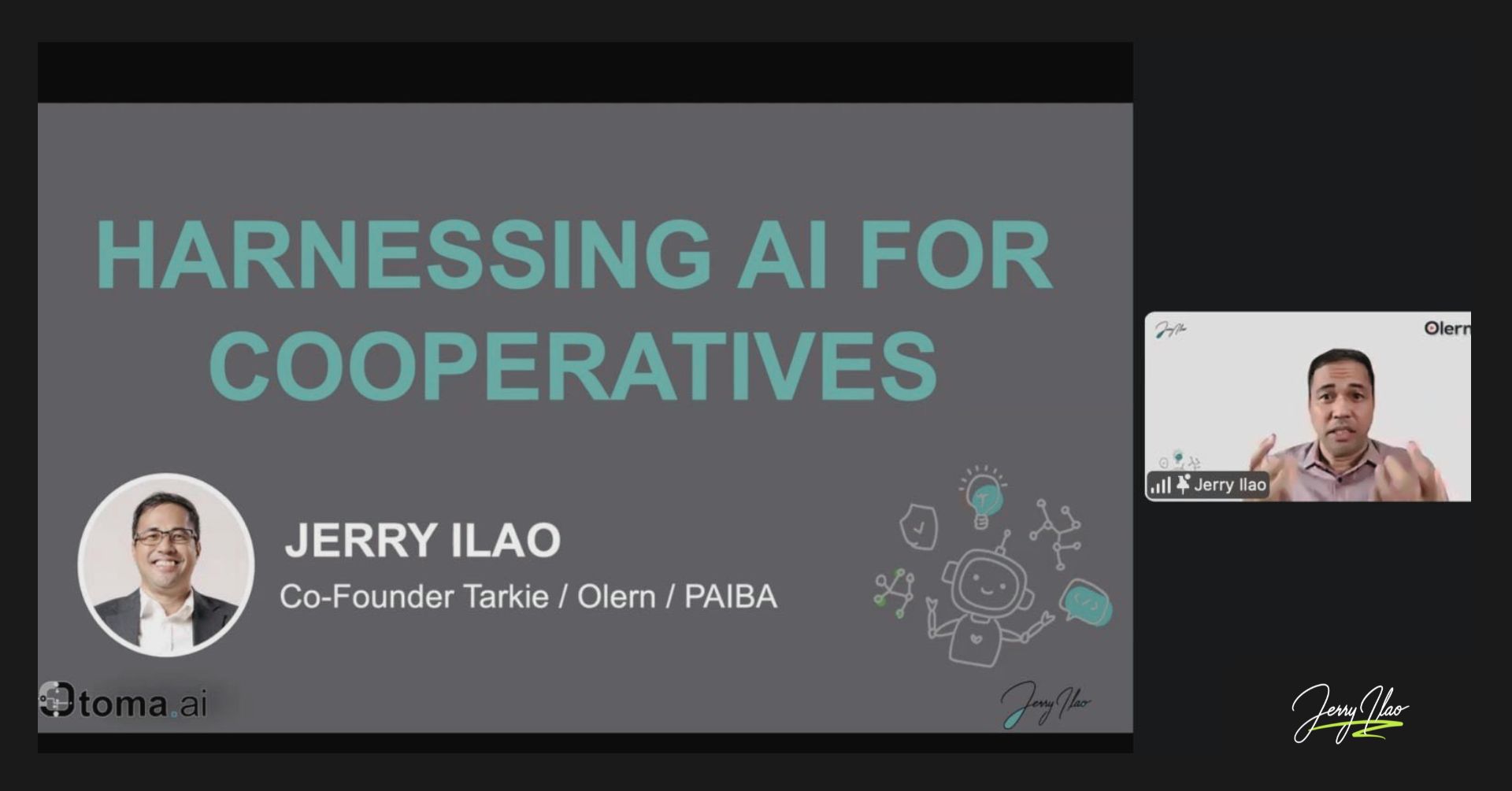

I recently had the privilege of training more than 70 cooperative leaders across Mindanao through MASS-SPECC, one of the largest federations of cooperatives in the region.
The participants were not startup founders or technology executives. They were board members, general managers, and operations heads of credit cooperatives, agriculture cooperatives, and multi-purpose cooperatives. People running real organizations with real members counting on them every month.
What stood out to me was this: the hunger to improve was already there. These leaders were not waiting to be convinced that change was necessary. They already knew it. What they needed was a concrete path forward.
Why cooperatives and NGOs are not exempt from the AI shift
A common assumption is that AI is for tech companies, or at least for businesses where speed and scale are the primary drivers. Cooperatives and NGOs, the thinking goes, are different. Their purpose is service. Their pace is deliberate. Their resources are constrained.
That reasoning is understandable.
And it is exactly the kind of reasoning that leads to being left behind.
The organizations serving the most vulnerable communities, managing the thinnest margins, and making the most complex resource decisions are precisely the ones that need better information, faster decisions, and more reliable processes. Artificial intelligence for nonprofits and cooperatives is not an upgrade for organizations that already have everything. It is a multiplier for organizations that need to do more with what they have.
The Philippine cooperative sector alone serves millions of members — from credit cooperatives in Mindanao to transport cooperatives in Metro Manila. The decisions those cooperatives make on credit assessment, procurement, and financial reporting have real consequences for real families. Improving those decisions by even a small margin is not a luxury. It is mission-critical work.
What actually happened in the MASS-SPECC sessions
This is not an abstract argument. It comes from direct observation.
Across the sessions in Mindanao facilitated through MASS-SPECC, three patterns showed up consistently among the cooperative leaders who attended.
The leaders who had tried anything AI-adjacent, even something as simple as using an AI assistant to draft board reports or summarize loan application summaries, saw the value immediately. They did not need a case study. They just needed to touch it once. The moment the tool removed 45 minutes of drafting work from their afternoon, the skepticism dissolved.
The leaders who were most cautious were not resistant to change. They were protecting themselves from tools that had been introduced before and then abandoned when vendor support ran out or the budget cycle shifted. That caution is legitimate, and it deserves a direct answer: start with tools you control and pay for directly, not tools dependent on a vendor relationship that might not last beyond the next procurement cycle.
Many of the leaders were already doing substantial informal data work: spreadsheets across multiple branches, handwritten logs, WhatsApp reports from field staff that never made it into any formal analysis. The raw material for better decision-making was already there. The capability to process it was not. AI does not replace that data. It finally makes it usable.
The specific gap cooperatives and NGOs need to close
The challenge is not access to AI tools. Most of the tools that matter cost less per month than a tank of petrol. The challenge is knowing which decisions to apply them to first.
Every cooperative and NGO has a small set of decisions that consume disproportionate time relative to their impact on members. Credit assessments that take three days when the data needed is already in the system. Compliance reports that take a full week of staff time to compile because no one has built a template. Annual planning sessions that rely on last year’s gut feel because no one had time to analyze last year’s actual data.
These are not technology problems. They are process problems that technology can help with — if the leader knows where to point it.
This is where the MASS-SPECC training focused. Not on general AI literacy. On identifying the two or three decisions in each cooperative’s calendar where AI assistance would create the most visible, immediate improvement in operations. That specificity is what separates a useful training session from an inspiring one that produces no change on Monday morning.
Four things to do if you lead a cooperative or NGO
Start with the decision that costs your team the most time. Every cooperative and NGO has a set of recurring decisions that take longer than they should: credit assessments, supplier evaluations, member compliance reports, budget projections. Pick one. Do not try to transform the whole organization at once. Find a tool that helps you process that one decision faster and more reliably, run it for 30 days, and measure the time saved. That measurement becomes your internal business case for the next step.
Treat AI as a drafting partner before anything else. The most accessible entry point for any organization is using AI to draft, summarize, and organize documents that someone was already going to write. Board resolutions, compliance reports, project narratives, financial summaries. The governance officer still reviews and approves everything. The AI removes the blank-page problem and compresses two hours of drafting into twenty minutes. Once the team sees how much time drafting used to take, adoption of other use cases usually follows without requiring additional training.
Run a visible experiment in your next planning cycle. Use AI to analyze the previous year’s operational data and prepare inputs for your annual planning session. Then show the process to your board — not just the output, but how the output was built. Visibility matters more than the tool itself. When leaders and board members see how the analysis was done, they trust it more. And they start asking how else it can be applied. That question is worth more than any training program.
Build your team’s confidence before you build their capability. In the MASS-SPECC sessions, the biggest barrier was not skill. It was the belief that AI was too complicated, too corporate, or not meant for their kind of organization. The fastest way past that belief is a small, visible win on a task the team already does. Not a pilot program with a project timeline. A single afternoon where someone drafts something faster than they ever have before. Start there.
The organizations that need this most are the ones that haven’t started yet
Whether you’re running a credit cooperative in Mindanao, a development NGO in Cebu, a school cooperative in Pampanga, or a civic federation anywhere in the country — if you’re not exploring how to use AI to improve operations and decision-making, you’re already falling behind, right?
Not because your competitors are racing ahead. But because the gap between what your organization is capable of and what it is actually doing grows a little wider every month you wait.
The Philippine cooperative sector, the NGO community, and every other mission-driven organization in this country deserves leaders who are honest about that gap and willing to close it.
AI is not going to transform your organization overnight.
But it can help you serve better, grow faster, and make smarter decisions — if you are willing to start.
The question is not whether AI applies to your organization. The question is whether you are going to be the one who figures out how to use it first, or the one who waits until you have no choice.
Frequently Asked Questions
Can cooperatives and NGOs actually use AI, or is it only for big companies?
Any organization with recurring decisions, recurring documents, and data it is not fully using is a candidate for AI adoption. Cooperatives and NGOs in the Philippines already have the raw material — member data, financial records, operational logs — needed to get value from basic AI tools. The barrier is not size or budget; it is knowing which process to start with.
What AI tools are most useful for cooperative management?
The most practical starting points are general-purpose AI assistants for drafting and summarizing documents (board reports, compliance filings, loan summaries), and spreadsheet-integrated AI tools for analyzing operational data. Cooperatives in Mindanao participating in MASS-SPECC training sessions found immediate value in using AI for report drafting before moving to more complex applications.
How long does it take for a cooperative or NGO to see results from AI adoption?
The fastest results come from drafting and document work, where time savings are visible within the first session. Decision-support applications (credit assessment inputs, budget projections) typically show measurable impact within one to two planning cycles after adoption. The critical variable is not the tool — it is whether the leader picks a specific, high-frequency task to start with rather than trying to adopt AI broadly all at once.
What is the biggest barrier to AI adoption in cooperatives and NGOs?
Based on training sessions with cooperative leaders through MASS-SPECC in Mindanao, the most common barrier is not technical skill — it is the belief that AI tools are too complex, too expensive, or not designed for mission-driven organizations. That belief typically dissolves after a single working session where the tool removes meaningful time from a task the team already does. The first win matters more than any training program.
Does using AI in a cooperative or NGO require a dedicated technology team?
No. The most impactful early AI applications for cooperatives and NGOs require no dedicated technical staff. Document drafting, data summarization, and report generation can be adopted by any staff member who handles those tasks today. Organizations should start with tools that do not require integration, customization, or IT support — and only build toward more complex deployments once the organization has developed basic confidence and identified higher-value use cases.