
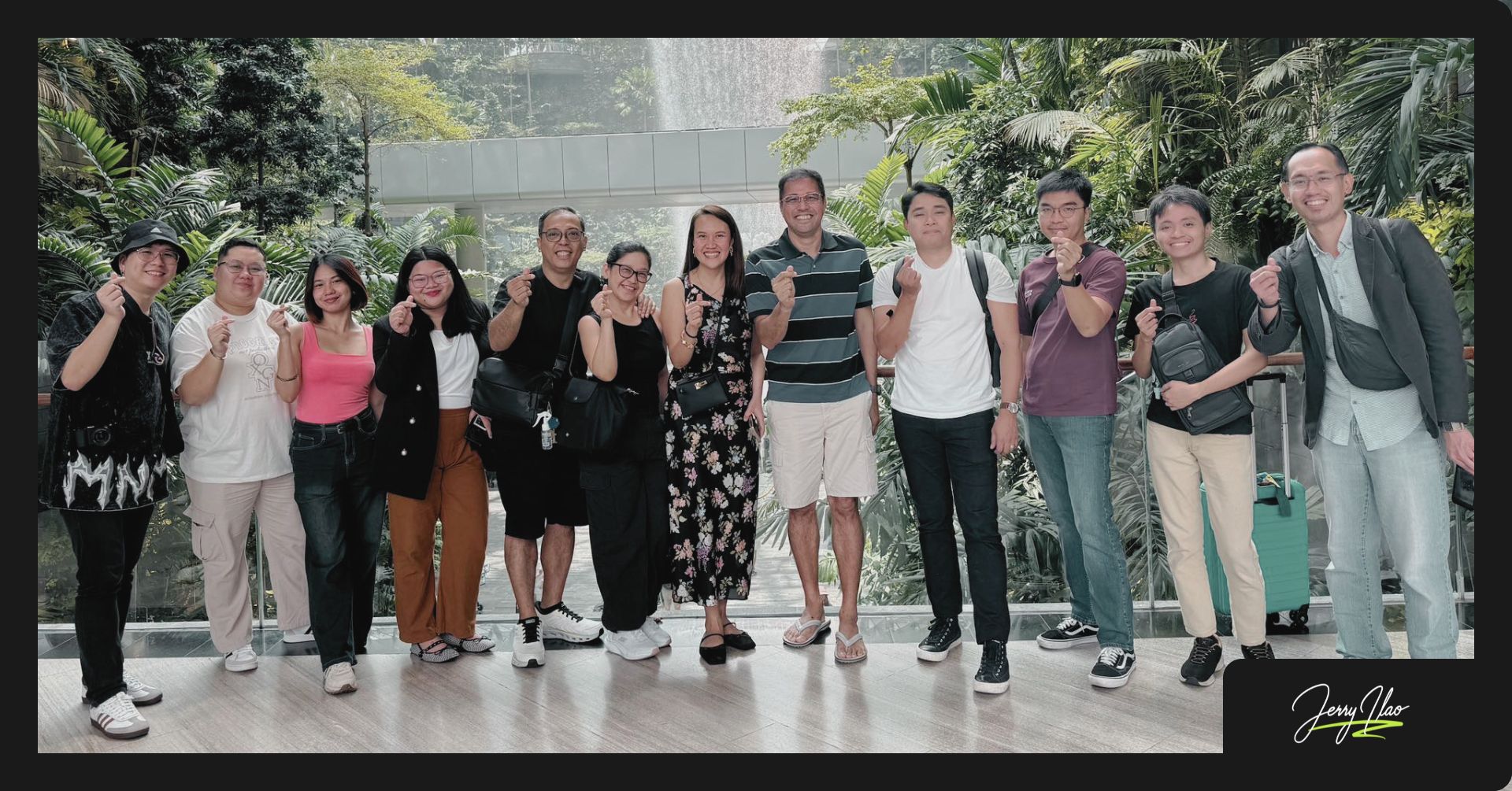

We brought our leadership team to Tech Week Singapore, one of the largest technology events in Asia.
Yes, it was a big investment. Flights, hotels, days away from the business, and an entire leadership group out of the office at the same time.
We knew that going in. And we knew it was worth it.
As a tech company, we spend most of the year heads-down. Building. Shipping. Fixing. Improving the product for the customers in front of us. That work matters, and it never really stops. The risk is that it quietly becomes the only thing we do.
Building is not the same as staying ahead
It is easy to confuse motion with progress. A team that ships every week feels like a team moving forward, and often it is. But shipping faster inside the same set of assumptions is not the same as staying ahead of where the market is actually going.
You want your best people thinking three steps ahead, right? That is hard to do when their entire field of view is the current sprint. The roadmap gets shaped by what the team already knows. And what the team already knows gets shaped by the same room, the same tools, and the same conversations they have every single day.
At some point, building more stops being the constraint. Seeing more becomes the constraint.
This is the part that does not show up in any sprint review. A team can be highly productive and still be quietly narrowing, because productivity inside a closed loop feels exactly like progress, right up until the day the market moves and the loop does not move with it. By then, catching up costs far more than staying current would have.
Why most leadership development misses this
When companies budget for leadership development, they usually picture a classroom. A trainer, a slide deck, a framework, a certificate at the end. That kind of training has its place. It builds vocabulary and gives people a shared model to work from.
But the leadership development that actually changes how someone leads often happens somewhere else. It happens when a leader steps outside their normal context and sees the field for themselves. A course tells you what is changing. Standing on a conference floor shows you how fast, how seriously other companies are taking it, and how far ahead the frontier has already moved.
This is why we treated the trip as an investment, not a reward. We were not sending people to be entertained. We were sending them to update their internal picture of what normal looks like in our industry.
Tech Week Singapore brings the wider technology ecosystem under one roof. Held at Marina Bay Sands, it drew more than 28,000 attendees across cloud, AI, infrastructure, cybersecurity, and data, spread over co-located shows for each of those areas. Walking a floor like that does something a webinar cannot. You see what is being built now, what is being funded now, and what serious companies are betting on next. You feel the pace of it in a way a recap article flattens out.
What exposure actually changes
When we sent our leaders out, we were not chasing a list of new tools. We were after something harder to put on a receipt:
Opening their minds. Seeing global perspectives. Understanding where the world is headed. Coming home with fresh ideas and energy.
None of those appear on a feature spec. All of them show up later, in the quality of the decisions a leader makes when the obvious answer is no longer good enough.
A leader who has seen where the frontier is moving asks sharper questions in a planning meeting. A leader who has only seen the inside of the office tends to defend the current plan, because the current plan is the only world they have looked at recently. That difference is small in any single meeting. Across a year of meetings, it compounds into a very different company.
There is a softer benefit too, and it is still worth paying attention to. People come back with energy. A leader who has just seen what is possible is harder to discourage and easier to rally. That kind of momentum is difficult to manufacture inside the office, and it tends to spread to the teams they lead.
This is also why we build the way we do. The leaders who run Tarkie and the rest of what we make at MobileOptima do not need another feature list handed to them. They need a wider sense of where the whole field is heading, so the features they choose to build are the right ones. The product is downstream of how the people leading it see the world.
The exposure gap is widest for smaller companies
This matters more, not less, for smaller companies. A large multinational has people whose entire job is to scan the market, attend the events, and report back. A growing company rarely has that luxury. The same handful of leaders who set the strategy are also the ones running operations, closing deals, and shipping the product. Their calendars fill with the urgent, and the important work of looking outward keeps getting pushed to next quarter.
That is the trap. The companies that most need a wider view are often the ones least able to make room for it. And the cost of staying narrow is not obvious in the moment. It shows up later, as a competitor who saw the shift earlier and moved on it while you were heads-down.
Much of my work through the Philippine AI Business Association (PAIBA) comes back to this same idea: helping Filipino businesses play bigger. Playing bigger does not start with a bigger budget. It starts with a bigger view of what is possible. A founder who has seen what comparable companies across the region are building stops benchmarking against the shop down the street and starts benchmarking against the frontier.
You do not need a multinational’s scanning budget to close that gap. You need to be deliberate about it. One or two well-chosen events a year, with the right people in the room and a clear mandate to bring something back, can do for a small leadership team what an entire department does for a large one. The advantage is not the size of the budget. It is the discipline of spending it on the right thing.
Four ways to make exposure real
If you lead a tech company and you have never put real budget behind exposure, here is where I would start. Each of these is something you can decide on this quarter.
Send your leaders to see the frontier, not just read about it. Reports and recaps are useful, but they arrive filtered through someone else’s priorities, and a summary rarely creates urgency. Standing in front of what other companies are shipping does. People act on what they have seen with their own eyes, not on what they skimmed in a deck. Pick the event that sits closest to where your industry is heading, not the one with the most familiar name.
Bring more than one person. A single attendee comes home with notes nobody else fully understands, and the insight quietly dies in their inbox. A group comes home with a shared reference point. When three of your leaders saw the same demo or heard the same warning, the conversation back at the office starts from agreement instead of translation. The cost is higher, but the return is a leadership team that is genuinely aligned on what they saw.
Give every attendee a debrief mandate. Before they go, ask each leader to come back with one idea worth acting on this quarter, and put a date on the share-out. Exposure without follow-through is just a nice trip. The mandate is what turns the experience into a decision the business can actually feel. Keep it to one idea per person so the debrief stays focused and something real gets done.
Protect the exposure budget first, not last. It is the easiest line to cut when the numbers get tight, and the slowest cut to feel the pain from. By the time the cost of falling behind finally shows up in your results, the savings are long gone and very hard to recover. Treat it as a fixed cost of staying current, the same way you treat the tools your team cannot work without.
Where to start this week
You do not need an overseas conference to begin. Pick one leader and one event, even a local one, and send them with a debrief mandate. See what they bring back, then decide whether to do it again. The habit of looking outward matters far more than the size of the destination, and it costs very little to test.
This is a leadership discipline more than a budget question. The leaders who stay curious tend to build companies that stay relevant. The ones who stop looking outward usually do not notice the cost until it is already expensive.
Because when your people grow, your company grows.
The best tech advantage isn’t just the software you build. It’s the mindset of the team behind it.
Frequently asked questions
Is sending leaders to conferences a good form of leadership development?
Yes, when it is structured. Conferences expose leaders to where their industry is actually heading, which classroom training cannot fully replicate. The value comes from pairing the exposure with a debrief mandate so each attendee returns with at least one idea to act on, turning the trip into a business decision rather than a perk.
What is Tech Week Singapore?
Tech Week Singapore is one of Asia’s largest business technology events, held at Marina Bay Sands in Singapore. Its 2025 edition drew more than 28,000 attendees across co-located shows covering cloud, AI, infrastructure, cybersecurity, and data. It is widely described as one of the region’s biggest B2B technology gatherings.
How do you measure the return on a leadership team offsite or conference trip?
The clearest measure is what changes after the trip. Track whether each attendee delivered the one idea their debrief mandate asked for, and whether any of those ideas became a real decision in the next quarter. The longer-term return shows up in the quality of questions leaders ask in planning and the speed at which the company adapts.
How many leaders should you send to an industry event?
More than one. A single attendee comes home with notes others struggle to use, while a small group returns with a shared reference point that makes alignment far easier. Sending two or three leaders costs more upfront but produces a leadership team that genuinely agrees on what they saw and why it matters.
What should a leadership team do after attending a tech conference?
Hold a debrief within a week, while impressions are fresh. Each attendee should present the single idea they committed to bring back, and the group should decide which ones become action items for the quarter. Without this step, the energy and insight from the event fade before they ever reach the business.