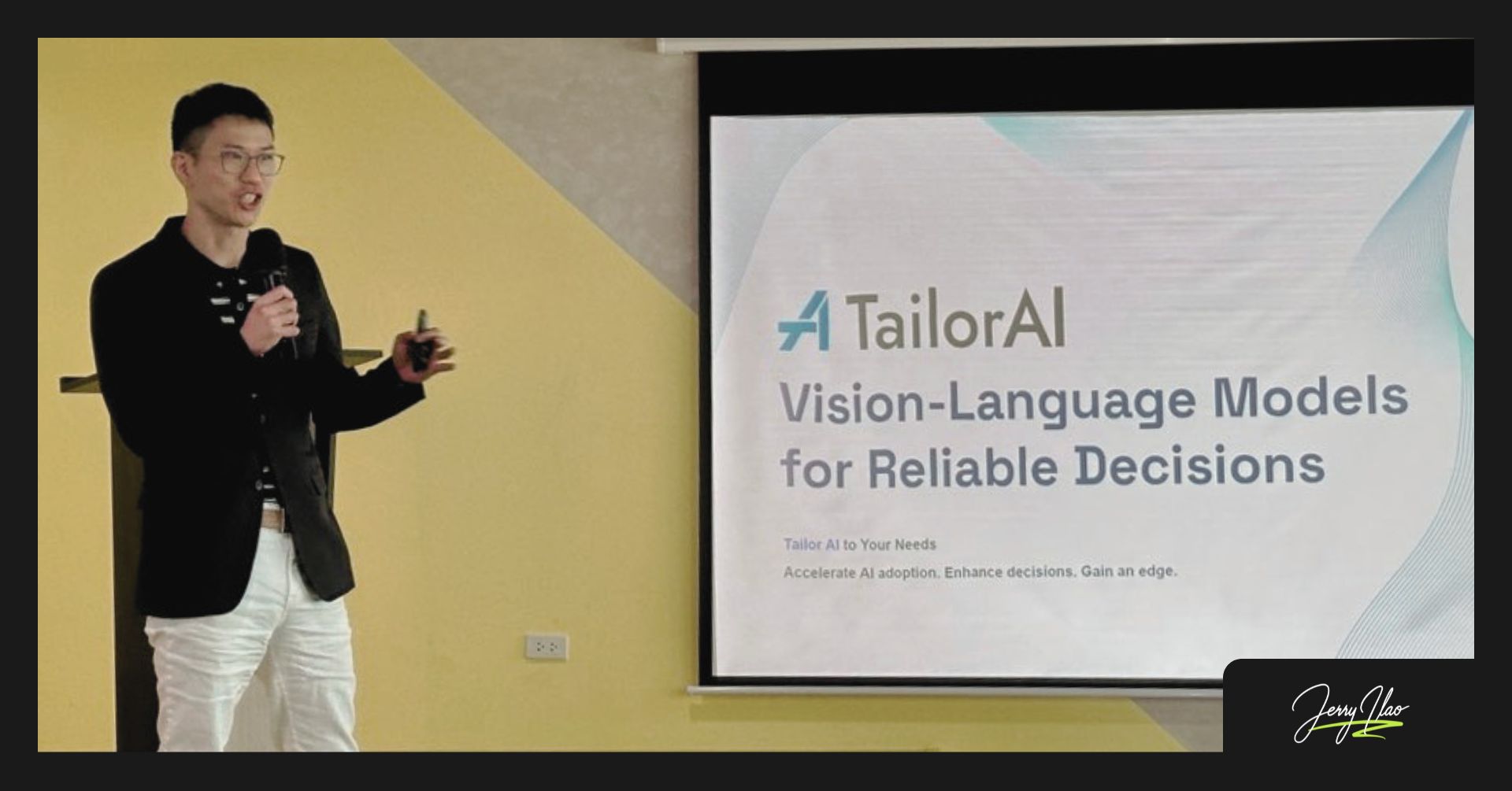

Something worth paying attention to came out of the UNI-PIPC AI Seminar. Dr. David Juan walked through three production deployments of Vision-Language Models for document intelligence. Not demos. Not proofs of concept. Systems handling real volume in hospitals, logistics companies, and warehouses right now.
What stood out to me was how grounded the use cases were. No grand claims about transforming industries. Just very specific problems, very specific results, and one category of AI technology doing work that traditional OCR and manual entry could not sustain.
What makes Vision-Language Models different from traditional OCR
For a long time, document automation meant OCR: scan the page, extract the characters, pass the string to a downstream system. It worked reasonably well for clean, printed text on standard forms. It broke down quickly on handwriting, mixed layouts, faded ink, and documents where meaning depends on context as much as characters.
Vision-language models close that gap differently. They process a document as both a visual artifact and a text artifact at the same time. They read layout, structure, handwriting, and printed text together, as an integrated whole. They understand that a signature in a specific box on a delivery form carries different meaning than the same signature elsewhere on the page. That contextual reading is what opens the use cases Dr. Juan described at the seminar.
Traditional OCR is character recognition. VLMs are closer to document comprehension.
Three production deployments worth studying
Prescription digitization
TailorAI built a system that replaces manual data entry for medical diagnosis records. Doctors’ handwriting, variable formats, dense medical terminology — the kind of document that has defeated automation for years because the cost of error is too high to accept low accuracy.
According to Dr. Juan’s presentation, the system achieves 90% accuracy and has measurably reduced both labor costs and transcription errors in the facilities using it. That number is worth reading carefully. The value of 90% automated is not just that 90% of the work happens without human hands. It is that reviewers can focus entirely on the 10% the model flags, rather than entering 100% while fatigued and catching errors inconsistently. The system changes what the human reviewer is doing, not just how much.
Proof of delivery parsing
Logistics companies process large volumes of delivery documents every day: printed fields, handwritten signatures, varying formats across customers and regions, documents arriving crumpled or photographed at odd angles. The deployment Dr. Juan described achieves 99% accuracy on printed text and 92% accuracy on handwriting, with an 80% reduction in manual processing time.
In a logistics operation handling thousands of deliveries daily, that 80% figure changes the staffing math entirely. The team that spent most of its time entering delivery confirmation data can now focus on exceptions, disputes, and the customer cases that actually need human judgment. The AI document processing handles the volume. The people handle the edge cases.
Warehouse defect detection
This one is a different expression of document intelligence. The system uses vision AI to identify damaged packages, count items, and record defects automatically during warehouse operations. It reduces the human error and dispute risk that comes from manual auditing, where a tired person with a clipboard makes count errors that surface days later as inventory discrepancies.
What used to require a walk-through with manual tallying now happens as a continuous, logged process. The audit record is more complete. The disputes are more defensible because the system creates timestamped evidence. The team’s attention moves from counting to decision-making.
Why these three use cases cluster together
Healthcare records, delivery documents, warehouse defect logs. On the surface, three very different industries. But they share the same structural problem: high document volume, high cost of error, and established manual workflows that people have been running for years.
That combination is exactly where document intelligence projects succeed fastest. The volume creates the economic case. The error cost creates the urgency. The established manual workflow creates the training data — because the humans who have been doing the work can tell you what correct looks like.
The organizations we work with at PAIBA and the teams running AI adoption programs through Olern have found that document-heavy processes are consistently among the strongest candidates for AI integration, for exactly these reasons. The signal is clear, the baseline is measurable, and the before-and-after comparison is easy to make.
What VLMs still cannot do on their own
It would be a mistake to read Dr. Juan’s results as proof that document intelligence is solved. The deployments he described are production results — which means they are what you get after working through the messy part that benchmarks do not capture.
The messy part includes: building training datasets from documents that vary by region and by customer, validating edge cases that only surface at volume, and designing the exception-handling workflow so that human reviewers stay effective rather than becoming rubber-stamp approvers. The TailorAI prescription system at 90% accuracy is impressive. Getting to 90% on medical documents required solving a different problem at each percentage point.
VLMs handle the volume. The exception workflow handles the rest. Both need to be designed well for the combined system to perform.
How to apply this to your own document processes
If you are a business leader thinking about where AI can reduce manual work, document-heavy processes are a strong starting point. Here is how to approach it practically.
Start with the documents that cause the most downstream errors. Not the highest volume, and not the easiest to digitize. The ones where a mistake creates a dispute, a delay, or a rework cycle downstream. Prescription errors and delivery disputes both fit this pattern because the cost of a wrong entry shows up clearly and quickly. That visibility makes measurement straightforward and makes the business case easy to defend.
Map the accuracy requirement before you evaluate any tool. A warehouse defect count at 85% accuracy might be operationally useful. A medical prescription at 85% accuracy carries patient safety risk. The accuracy threshold is not a technology question — it is a business and compliance question that needs to be answered before you talk to any vendor. Dr. Juan’s numbers are production benchmarks for specific document types. They are reference points for calibration, not guarantees for your context.
Run a pilot on a single document type with a clear success metric. The teams at PAIBA and the organizations we support through Olern reach production faster when the initial scope is tight: one document type, one workflow, one measurable outcome. Resist the temptation to prove the concept across five document categories at once. Prove it on one, get it to production, then expand.
Design the exception-handling workflow before you finish the pilot. The system flags exceptions. A human handles them. That sounds simple. In practice, the way you route exceptions, how you track resolution, and how you feed corrections back into model improvement determines whether your accuracy improves over time or plateaus. Build this into the project from the start.
Measure the human reviewer’s work, not just the model’s accuracy. The 80% time reduction in the logistics deployment is a human metric, not a model metric. That is the number that justifies the investment to a CFO. Track how the human team’s hours shift, not just what the model scores on a test set.
The broader pattern worth noticing
These three use cases describe the same underlying shift: replacing the person whose entire job was reading a document and typing what it said into a system. That person’s time does not disappear when the AI handles the volume. It moves to exceptions, to quality oversight, to the decisions that require judgment rather than transcription.
In the Philippines, where document-intensive industries including healthcare, logistics, and manufacturing operate at significant scale, this shift is not a future scenario. The deployments Dr. Juan described are running now. The question is not whether document intelligence applies to your industry. It probably does. The question is which document type you start with and how fast you can get that first deployment to a production-quality accuracy threshold.
The teams that move first get the operational data. That data improves the model. The model improves the exception rate. The business case builds on itself.
If you are running AI document processing in your organization, I would be curious what accuracy thresholds you are working with and where the edge cases are appearing.
Frequently Asked Questions
What is document intelligence and how does it differ from OCR?
Document intelligence refers to AI systems that can extract, interpret, and structure information from documents by understanding both the visual layout and the text content together. Traditional OCR (optical character recognition) reads characters mechanically without understanding context or layout. Document intelligence systems, particularly those built on vision-language models, understand what information means within a document, not just what it says.
What accuracy rates are achievable with VLM-based document intelligence?
According to Dr. David Juan’s presentation at the UNI-PIPC AI Seminar, production deployments show 90% accuracy for medical prescription digitization, 99% accuracy for printed text in delivery documents, and 92% accuracy for handwritten text in logistics operations. These are production figures from deployed systems, not benchmark scores on test datasets.
How much time can document intelligence save in manual processing?
The logistics proof-of-delivery deployment Dr. Juan described at the UNI-PIPC AI Seminar achieved an 80% reduction in manual processing time. Comparable deployments in financial services reported by industry research have shown 83% reductions in document processing time. Results depend heavily on document type, volume, and how the exception-handling workflow is designed.
What industries benefit most from document intelligence?
Industries with high document volume, high error cost, and established manual workflows benefit most. Healthcare (prescriptions, patient records), logistics (delivery confirmation, shipping documents), and warehousing (inventory records, defect logs) are strong candidates. The pattern holds across any industry where a document enters a workflow, requires data extraction, and mistakes in that extraction create downstream costs.
What does a good document intelligence implementation require beyond the AI model?
A good implementation requires three things beyond the model itself: a training dataset built from real documents in the target context, a well-designed exception-handling workflow that routes flagged documents to human reviewers efficiently, and a feedback loop that uses reviewed exceptions to improve model accuracy over time. Many implementations plateau in accuracy because the exception workflow was not designed as part of the system.
Is document intelligence ready for regulated industries like healthcare in the Philippines?
Production deployments exist in healthcare settings, including the TailorAI prescription digitization system described by Dr. David Juan at the UNI-PIPC AI Seminar. Readiness depends on the specific regulatory requirements of the use case and the accuracy threshold required for patient safety. A human-in-the-loop design, where the AI handles volume and humans review flagged cases, is standard for regulated applications.