
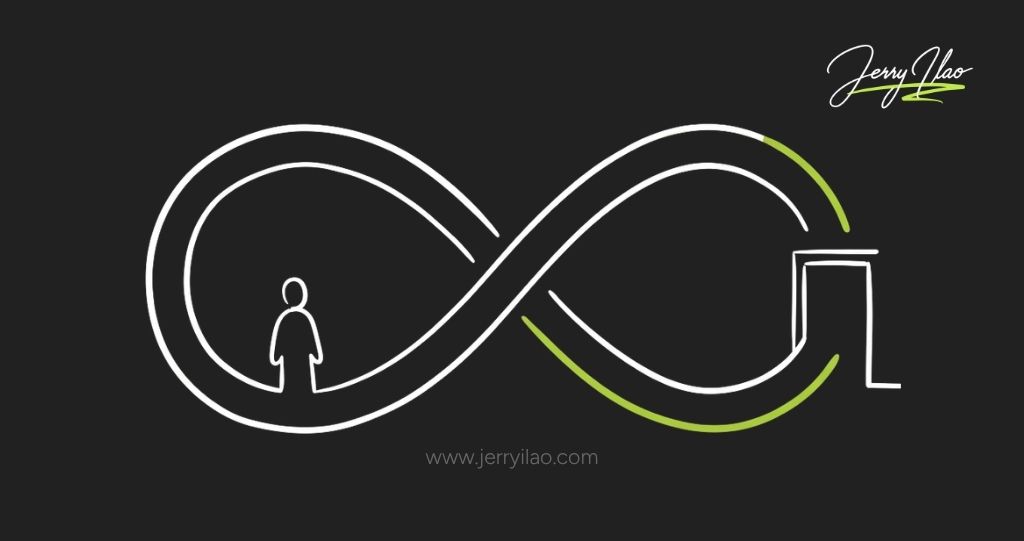

Google’s Messy Middle research, first published in 2020 by Alistair Rennie and Jonny Protheroe of Google’s consumer insights team and updated in 2023, shows that buyer decisions are not linear. Between the trigger and the purchase lies a loop of exploration and evaluation where most sales are won or lost. Filipino businesses that stay present in that loop close more deals.
Something I’m starting to observe in the workshops I run through Olern: most business owners in the Philippines still think of selling as a straight line. They learned AIDA — Attention, Interest, Desire, Action — and they treat it as a map. Put out an ad, build interest, close the sale.
The map is not wrong. It’s just incomplete.
Because between “I’m interested” and “I’m buying,” something happens that AIDA does not account for. Customers hesitate. They check three competitors. They ask a group chat. They watch a YouTube explainer at 11pm, decide they’re ready, then get distracted and forget about it for two weeks.
That space between interest and purchase is what Alistair Rennie and Jonny Protheroe of Google’s consumer insights team called the Messy Middle. They studied over 310,000 purchase decisions across multiple product categories and mapped how real buyers actually move from trigger to transaction.
What they found: the process is not linear. It loops.
What Actually Happens Between “Maybe” and “Yes”
The Messy Middle has two modes. Exploration is expansive — the buyer searches broadly, discovers options, and builds a mental picture of what’s available. Evaluation is reductive — the buyer narrows down, compares, and works toward a choice.
The problem is that people don’t move cleanly from exploration to evaluation and then to purchase. They flip between the two. They evaluate a product, get uncertain, and go back to exploring. They settle on a choice, see a competitor’s ad, and start evaluating all over again.
Rennie and Protheroe, working alongside behavioral science firm The Behavioural Architects, identified six cognitive biases that shape behavior inside the Messy Middle. Social proof pulls buyers toward what others have chosen. Authority builds trust when someone credible recommends a product. Scarcity and urgency accelerate decisions when supply appears limited.
For Filipino buyers, this loop has some added layers. Group chats are research tools. A recommendation from a tita or a former officemate carries more weight than a Facebook ad. The barkada’s approval matters. Before someone buys something significant, they will almost always ask someone they trust first.
Your marketing plan probably doesn’t account for that barkada conversation.
Why 80% of Sales Fall Apart in the Loop
This is where most businesses lose customers. Not at the awareness stage. Not at the interest stage. They lose them somewhere in the middle, while the buyer is looping.
The buyer didn’t decide against you. They got stuck.
They checked your website. Then they checked a competitor’s. Then they found a Facebook group where someone had a complaint about your industry, and they hesitated. Then they saw someone else running an ad with a stronger guarantee, and they compared. Then their phone rang and they forgot about the whole thing.
A week later, you’re not top of mind anymore.
At Olern, when we work with SMEs on their sales processes, we consistently see the same gap: the follow-up systems are thin or nonexistent. Businesses invest heavily in getting attention and almost nothing in maintaining presence through the Messy Middle. The money goes into the first impression and then the company goes quiet.
That’s where deals go to die.
Two Things You Can Do Right Now
This is not a theory problem. It’s an execution problem. And the fix is not complicated.
Stay in the loop
Retargeting exists precisely because buyers don’t convert on the first visit. If someone has visited your landing page, they’ve already expressed interest. A retargeting ad on Facebook or Instagram puts you back in front of them while they’re still comparing. Show testimonials. Show results. Show someone who looks like them succeeding with your product.
The goal is not to overwhelm. The goal is to stay present. One well-placed testimonial post a week is enough to remind someone who’s on the fence that you’re still there, you’re still delivering, and other people chose you and did not regret it.
Be visible on multiple channels too. A Filipino buyer who’s evaluating something important will usually encounter you more than once before they commit. They’ll see a post, then a video, then a story, then maybe a comment you left on someone else’s thread. Each touchpoint adds to the trust stack.
Shorten the loop
The other option is to make the decision easier.
Add genuine urgency where you can: early bird pricing, limited cohort slots, a bonus that disappears after a certain date. Not fake urgency. Fake urgency breaks trust and Filipinos are very good at spotting it. Real urgency means there’s an actual reason to decide now.
Simplify the offer down to one outcome and one next step. When buyers are in the Messy Middle, they’re already overwhelmed with choices. Your job is to reduce the cognitive load, not add to it. One clear outcome. One clear action. Remove friction everywhere you can: make checkout fast, make the guarantee obvious, make the contact process easy.
The buyer who’s been looping for two weeks is often one clear, low-friction offer away from committing.
The Closer Question Marketers Never Ask
Most marketers ask: “Why didn’t they buy?”
Better question: “Where in the loop did they stop, and what would it have taken to guide them out?”
The answer is almost never “they didn’t want it enough.” Filipino buyers who’ve done three weeks of research and asked five people for opinions clearly want the thing. They’re not indifferent. They’re uncertain. And uncertainty is curable.
Not with pressure. With clarity.
A clear guarantee removes one uncertainty. A visible community of satisfied buyers removes another. A simple, frictionless checkout removes the last one. Taken together, they pull someone out of the loop and into the decision.
The buyer didn’t forget you. They were waiting for you to make it easy.
Frequently Asked Questions
What is Google’s Messy Middle research? The Messy Middle is a buyer behavior framework developed by Alistair Rennie and Jonny Protheroe of Google’s consumer insights team, in collaboration with behavioral science firm The Behavioural Architects. First published in 2020 and updated in 2023, the research studied over 310,000 purchase decisions to map how buyers move between a triggering event and a final purchase.
Why doesn’t the AIDA model explain modern buyer behavior? AIDA describes Attention, Interest, Desire, and Action as a linear sequence. Real buyers don’t move linearly. Between interest and action, they loop through exploration and evaluation repeatedly, consulting multiple sources, comparing alternatives, and hesitating before committing. AIDA doesn’t account for the time and uncertainty that live between desire and purchase.
What are the two modes in the Messy Middle? Google’s research identifies exploration and evaluation as the two mental modes. Exploration is expansive: the buyer searches broadly and discovers options. Evaluation is reductive: the buyer narrows down and compares. Buyers flip between these two modes repeatedly rather than moving through them once in sequence.
What does the Messy Middle look like for Filipino buyers specifically? Filipino buyers often rely on trusted social networks — group chats, balikbayan recommendations, family opinions — as research inputs. These conversations happen outside your marketing channels and can extend the loop significantly. A buyer may be personally ready to commit, but waiting for one trusted person to affirm the choice before they act.
How do you shorten the buyer’s decision loop? Reduce cognitive load by simplifying your offer to one outcome and one next step. Add genuine urgency where it exists (limited slots, time-bound bonuses). Remove friction from checkout and guarantees. Each simplification removes one source of uncertainty, and uncertainty is what keeps buyers looping.
What is retargeting and why does it matter in the Messy Middle? Retargeting shows ads to people who have already visited your page or engaged with your content. In the Messy Middle, these are buyers who’ve already expressed interest. Retargeting keeps you present while they compare alternatives, showing social proof and results to reinforce trust rather than rebuilding awareness from scratch.