
AI subscriptions are cheap. Ignoring them is expensive.
That might sound like a sales pitch. It isn’t.
The conversation about whether AI tools are “worth trying” is effectively over for most industries. The organizations asking that question today are not at the start of a considered evaluation process. They are behind a group of peers that began experimenting in 2023, ran pilots in 2024, and started scaling in 2025. The pace differential between those two groups is no longer marginal.
The cost that doesn’t show up on an invoice
When teams avoid AI in the workplace, the decision feels neutral. Nothing is being spent, so nothing is being lost.
But something is being lost.
The hours spent reformatting the same report that took forty-five minutes and could take eight. The delayed decisions because a market analysis took a week instead of an afternoon. The missed opportunities because no one had bandwidth to surface the insight buried in three months of customer data. Competitors reading the same signals, moving faster.
None of that appears on an expense report. It shows up in pace, in output quality, and eventually in margin.
The real cost of avoiding AI is not the subscription fee. It is the friction that stays in the workflow when the friction did not have to be there.
What leverage actually means in this context
“Leverage” is an overused word in business writing. In the context of AI tools for the workplace, it has a specific meaning worth unpacking.
When a team uses AI well, they are not just doing existing tasks faster. They are changing the ratio between the time spent on execution and the time available for judgment. A first draft that used to take two hours now takes twenty minutes. That is not a 90% time saving — it is ninety minutes returned to the work that actually requires a human: reviewing the argument, stress-testing the logic, deciding what the output is for.
That shift compounds. When it happens across a team, across a month, across a quarter, the team that adopted AI is not slightly ahead. They are operating at a different level.
In work done through PAIBA and with teams building through Olern, the pattern repeats consistently: the teams that move fastest are not the ones with the best prompts or the most sophisticated tools. They are the ones who stopped treating AI as a separate workflow and built it into how work gets done.
The era of AI agents changes the baseline
The comparison that organizations need to make is no longer between “using AI” and “not using AI.” It is between moving now and moving later, while later keeps receding.
We are entering the era of AI agents: tools that do not just assist but actually execute. Researching. Drafting. Analyzing. Completing tasks on behalf of teams without a human triggering each step. This is not speculative. Teams at companies across Philippine industries — logistics, financial services, retail — are already running agent workflows that handle intake, summarization, and routing without manual intervention at each node.
Some organizations are still running the numbers on whether to start.
Others have already delegated the work.
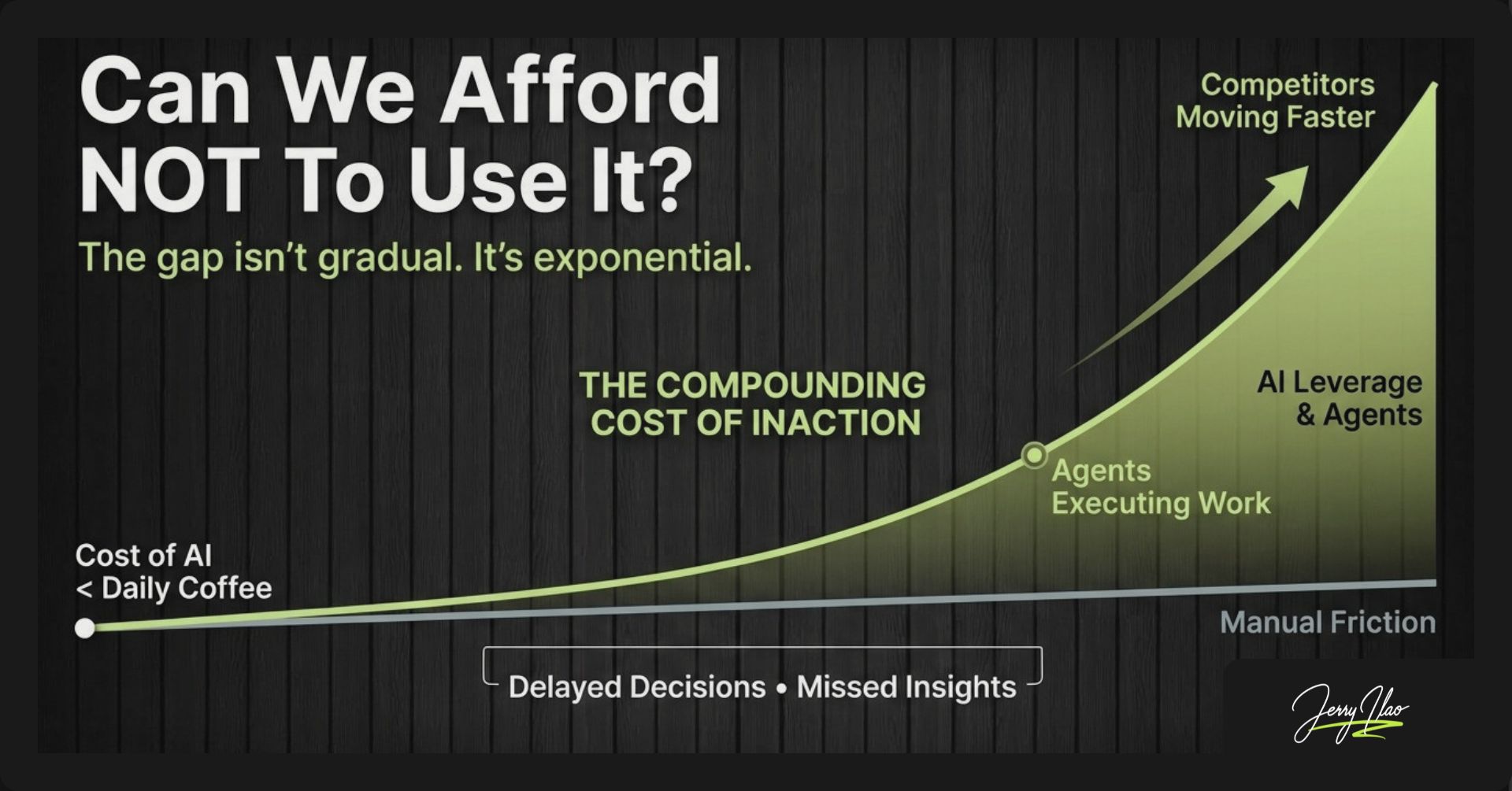
The gap between those two positions is not gradual. It compounds every day.
Why the hesitation persists
The hesitation is rarely about price. A ChatGPT Plus subscription, a Claude Pro plan, or a Microsoft Copilot seat costs less than a team lunch. That is not what is holding organizations back.
What holds them back is one of three things.
The first is workflow friction. Introducing a new tool requires changing a habit. People default to what they know, even when what they know is slower. The tool sits unused not because it is hard, but because the old way is automatic.
The second is unclear ownership. Nobody in the organization has been asked to be responsible for AI adoption. The IT team is waiting for a directive. The department heads are waiting for a policy. The employees are waiting for permission. In the absence of a clear owner, nothing moves.
The third is fear of the wrong first step. Organizations overestimate the commitment required to start. Paying for a subscription feels like committing to a full rollout. It does not. A month-long pilot with one use case and one person is enough to generate data.
The hesitation is understandable. It is also expensive.
What to do this week
Pick one repetitive task and run it through an AI tool. Not your most complex work. The task that feels like maintenance: summarizing a meeting, drafting the first version of a proposal, researching options before a call. Run it this week. Measure the time it saves compared to your usual approach. The data from one task is more persuasive than any article about AI adoption.
Use AI visibly in front of your team. Adoption spreads faster when people see it in action than when they read about it in a memo. The next time you prepare for a meeting using ChatGPT, Claude, or Gemini, say so. Show the output. Walk through what you asked and what you got. Curiosity follows visibility.
Assign an owner. Choose one person, or take on the role yourself, whose job it is to track how your team is using AI tools this quarter. Not to build a strategy document. To watch what is working, what is not, and to share what they learn. A single curious person with permission to experiment moves an organization faster than a committee with a roadmap.
Treat the first month as a test, not a commitment. Pay for one subscription. Set one use case. At the end of the month, answer one question: did this return more time than it cost? If yes, expand. If no, change the use case. The test is the strategy.
The question that actually matters
For several years, the question organizations asked was: “Can we afford AI?”
That question is no longer the right one.
Can we afford NOT to use it?
Because the companies building the widest gap right now are not doing anything complicated. They are using AI in the workplace while their competitors are still running the numbers on whether to start. The gap between those two groups is not closing. Every day of delay is another day of compounding.
The subscription fee is the smallest part of the decision. The largest part is pace.
Frequently Asked Questions
What is the real cost of not using AI at work?
The direct cost of avoiding AI is not the subscription fee, it is the accumulated friction: time spent on repetitive tasks that AI tools could handle in minutes, delayed decisions from slow analysis, and a widening gap against competitors who are already operating faster. This cost does not appear on a budget line, but it shows up in output pace and organizational capacity over time.
How much do AI subscriptions typically cost for a business?
Most individual AI tool subscriptions range from roughly $20 to $30 USD per user per month. For Philippine teams, this is the equivalent of a few days of salary for a mid-level employee. The productivity return, when the tool is used consistently on the right tasks, typically offsets this within the first week of regular use.
What does AI in the workplace actually look like for a Philippine business?
For most Philippine businesses, AI in the workplace starts with writing and summarization: drafting proposals, summarizing meeting notes, preparing reports. Teams at organizations working with PAIBA have extended this to customer communications, data analysis, and, more recently, agent workflows that handle intake and routing tasks with minimal manual intervention per step.
What are AI agents and why do they matter for teams?
AI agents are tools that do not just assist with a task but execute a sequence of steps autonomously: researching, drafting, analyzing, and routing outputs without a human triggering each action. They matter because they shift AI from an assistant model (a human delegates one task at a time) to an execution model (a human sets a goal and the agent completes the workflow). Teams that have integrated agents are operating at a fundamentally different capacity than those using AI only for single-task prompting.
How do I get my team to actually use AI tools?
The fastest path is visibility and ownership. Use AI tools in front of your team so they see the output, not just hear about it. Assign one person to track what is working and share it. Start with one use case where the time saving is obvious and measurable. Teams that adopt AI through visible demonstration move faster than those that adopt it through policy documents or mandatory training.
Is it too late to start using AI at work?
It is not too late, but the gap is real and it compounds. Organizations that started in 2023 have eighteen months of workflow integration, team habits, and agent deployment experience that a team starting today does not. Starting now is still significantly better than starting in six months. The correct frame is not whether to start but how fast to move once you do.