
An effective AI transformation strategy treats AI as a leadership agenda, not an IT project, because AI now reshapes business models rather than just cutting costs. Gartner’s 2026 CIO survey found 64% of technology executives plan to deploy agentic AI within 24 months, marking the shift from pilots to delivery.
The companies that pull ahead in this window are not the ones with the largest AI budgets or the most tools. They are the ones whose leaders make AI a standing leadership agenda, redesign workflows around it instead of patching it on, assign clear ownership for adoption, and create real time for their people to learn.
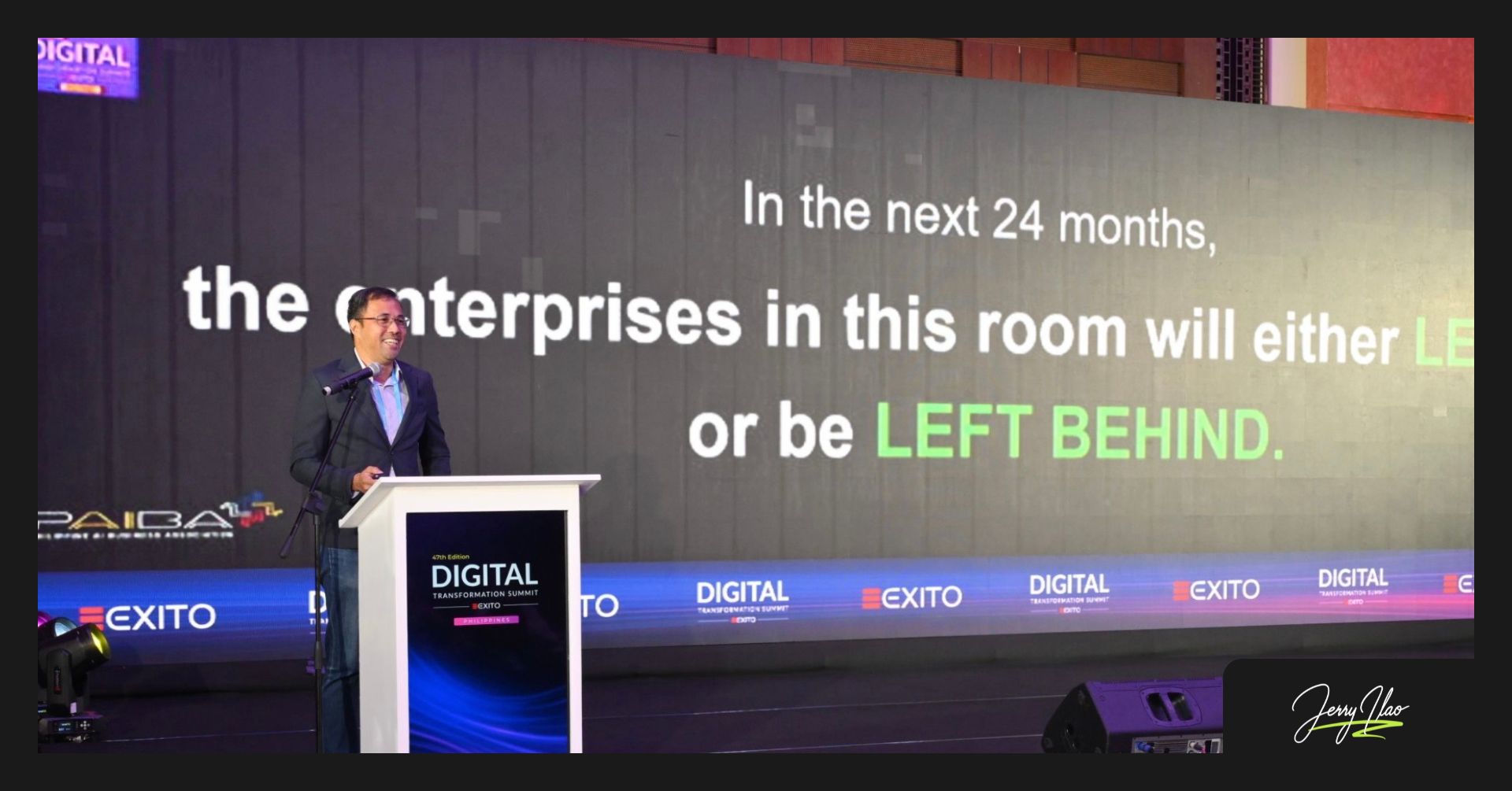
I truly believe companies have 24 months to lead or be left behind.
That was one of the key messages I shared during my opening keynote at the Digital Transformation Summit at the Marriott Ballroom. I was speaking to technology leaders from companies and industries across the Philippines, and I wanted to be direct about it, because I think the timeline is real and the window is narrower than most boards assume.
Let me explain why I believe that, and what I think it actually asks of the people running these organizations.
Why this technology shift is different from the ones before it
For many years, technology adoption was mostly about improving efficiency and reducing costs. You bought a new system, you trained people on it, and you measured the savings. The technology changed, but the business model around it stayed roughly the same. A faster accounting system did not change what business you were in. It just made the same business cheaper to run.
AI is different.
We are no longer just talking about cost savings. We are talking about business models being disrupted. Industries being reshaped. Companies being forced to rethink how they operate, how they compete, and how they create value. That is a different category of change, and it does not respond to the same playbook that worked for the last two decades of IT upgrades.
The evidence for the timeline is consistent across the major research houses. Gartner’s 2026 CIO survey of more than 2,500 technology executives found that 64% plan to deploy agentic AI over the next 24 months, and Gartner’s own framing of the moment is blunt: 2025 was about pilots, discovery, and experimentation, while 2026 is about delivering real returns from agentic AI. McKinsey’s own AI transformation guidance, along with reporting from PwC and EY, describes the same shift in the same direction, from scattered experiments to execution at scale, with a widening gap between the companies that scaled and the ones that stayed in pilots. The pilot phase is closing. The companies still treating AI as a side experiment are spending the window other companies are using to move.
Why an AI transformation strategy is a leadership agenda, not an IT project
Here is the part I most wanted the CXOs in the room to sit with. AI cannot be treated as just another IT project. It has to be a leadership agenda.
When something is an IT project, it gets a budget line, a vendor, a project manager, and a go-live date. It is contained. It is delegated. The executives sponsor it, check in at the steering committee, and move on. That model works well for a new payroll system or a CRM migration, because those projects have clear edges.
AI does not stay contained. It touches how decisions get made, how teams are structured, what work gets automated, and what your people spend their hours on. It changes the shape of jobs. It changes which skills matter. You cannot hand that to a department and treat it as a delivery milestone, because the hardest part of it is not technical at all.
You have probably seen what happens when a transformation gets handed entirely to IT, right? The tools get installed. The licenses get bought. The dashboards get built. And six months later, adoption is still low, because the part that actually changes a company, people changing how they work, was never anyone’s job. The technology was ready. The organization was not.
This is why the companies that will pull ahead are not necessarily the ones with the most tools or the biggest budgets. They are the ones whose leaders are willing to move fast, rethink old assumptions, and bring their people along. Tools are easy to buy. Leadership attention is the scarce resource, and it is the one that decides whether AI becomes part of how the company works or just another line in the technology budget.
What this means for MSMEs, not just large enterprises
There is a version of this conversation that only large enterprises get to have, and I want to push back on it. The instinct is that AI transformation belongs to companies with big technology teams and big budgets. For micro, small, and medium enterprises, which are the backbone of the Philippine economy, that instinct is wrong, and it is dangerous.
AI is one of the few shifts that actually narrows the gap between small and large companies. A small business can now access capabilities in analysis, customer support, content, and operations that used to require teams it could never afford. The leverage is real, and it is available now.
But the 24-month window applies to MSMEs too. Maybe more so. A large company can absorb a slow start. A smaller company that waits while competitors learn to operate with AI can find itself out-executed by businesses its own size. The leadership agenda point is not about company size. It is about whether the person running the business decides this is theirs to own.
What leaders should actually do this week
Conviction without a next step is just a keynote line. So here is what I would tell a leadership team to do, starting this week. None of these need a large budget. They need leadership attention.
Put AI on the leadership agenda, literally. Add it as a standing item in your executive meetings, not a quarterly update from IT. If it is not on the agenda where strategy and people decisions get made, it will keep being treated as a procurement question. Make it a recurring conversation among the people who own the business model, and keep it there until AI is simply part of how you run the company.
Pick one workflow you own and rethink it out loud. Do not start with a company-wide transformation. Choose one process inside your own function, your sales handoff, your monthly reporting, your customer onboarding, and ask what it would look like if it were redesigned around AI rather than patched with it. Rethinking one assumption visibly, where your team can watch you do it, teaches more than any memo about innovation.
Name who owns adoption. Most AI efforts have someone who owns the tools and no one who owns whether people actually use them. Assign that ownership explicitly, to a person with enough authority to change how teams work. Adoption is a people outcome, and people outcomes need an owner, not a vendor contract.
Create space for your people to learn. Moving fast and bringing people along are in tension, and leaders have to manage that tension on purpose. Block real time for your teams to experiment and get comfortable with the tools. If every hour is already spoken for, learning becomes the thing that never happens, and adoption stalls quietly while everyone stays busy.
The window is real, and so is the choice
The next 24 months will be critical. I do not say that to create panic. I say it because the evidence is consistent, and because I see the same pattern in the conversations I have with business leaders across industries. The research houses are describing a shift from experimentation to execution. The leaders who are moving are not waiting for certainty. They are deciding, then adjusting.
Some companies will lead.
Some will be left behind.
The companies that lead will not be the ones that bought AI first. They will be the ones whose leaders decided early that this was their agenda to own, and acted on it before the window closed. The companies that fall behind will not fail because the technology was unavailable to them. It was available to everyone. They will fall behind because their leaders treated a business transformation as a technical errand.
So the real question is not whether your company will adopt AI. Almost every company will, eventually. The real question is whether you will lead that adoption, or inherit it late from competitors who moved while you waited.
The next 24 months will decide which one we choose to be.
Thank you to Exito Media Concepts for the opportunity to share these insights with technology leaders from different companies and industries across the Philippines. Conversations like this one are how we move the whole ecosystem forward.
Frequently asked questions
An AI transformation strategy is a company’s plan for adopting AI across its operations, workflows, and decision-making, rather than running isolated tool pilots. An effective one is owned at the leadership level because AI changes business models, job design, and how teams work, which are decisions a technology department cannot make alone.
Research houses including Gartner, McKinsey, PwC, and EY describe 2025 to 2026 as a structural shift from AI pilots to AI execution at scale. Gartner’s 2026 CIO survey found that 64% of technology executives plan to deploy agentic AI within 24 months. Companies that stay in the experimentation phase risk being out-executed by competitors who use the same window to embed AI into core operations.
An IT project has clear edges: a budget, a vendor, and a go-live date, which makes it easy to delegate. AI does not stay contained, because it changes how decisions are made, how teams are structured, and what work people do. Those are leadership questions, so AI adoption needs executive ownership rather than being handed entirely to a technology department.
Yes, and arguably with more urgency. AI narrows the capability gap between small and large companies by giving MSMEs access to analysis, support, and operational tools that previously required teams they could not afford. A smaller business that delays while competitors of similar size learn to operate with AI risks being out-executed in its own market.
Put AI on the leadership agenda as a standing item in executive meetings, not as a quarterly IT update. From there, pick one workflow the leader personally owns and redesign it around AI, assign clear ownership for adoption, and block real time for teams to learn. None of these steps require a large budget.
AI initiatives often stall because the tools get installed but no one owns whether people actually change how they work. Adoption is a people outcome, not a software outcome. When a transformation is delegated entirely to IT, the technical setup gets done while the harder organizational change has no owner, and usage stays low.