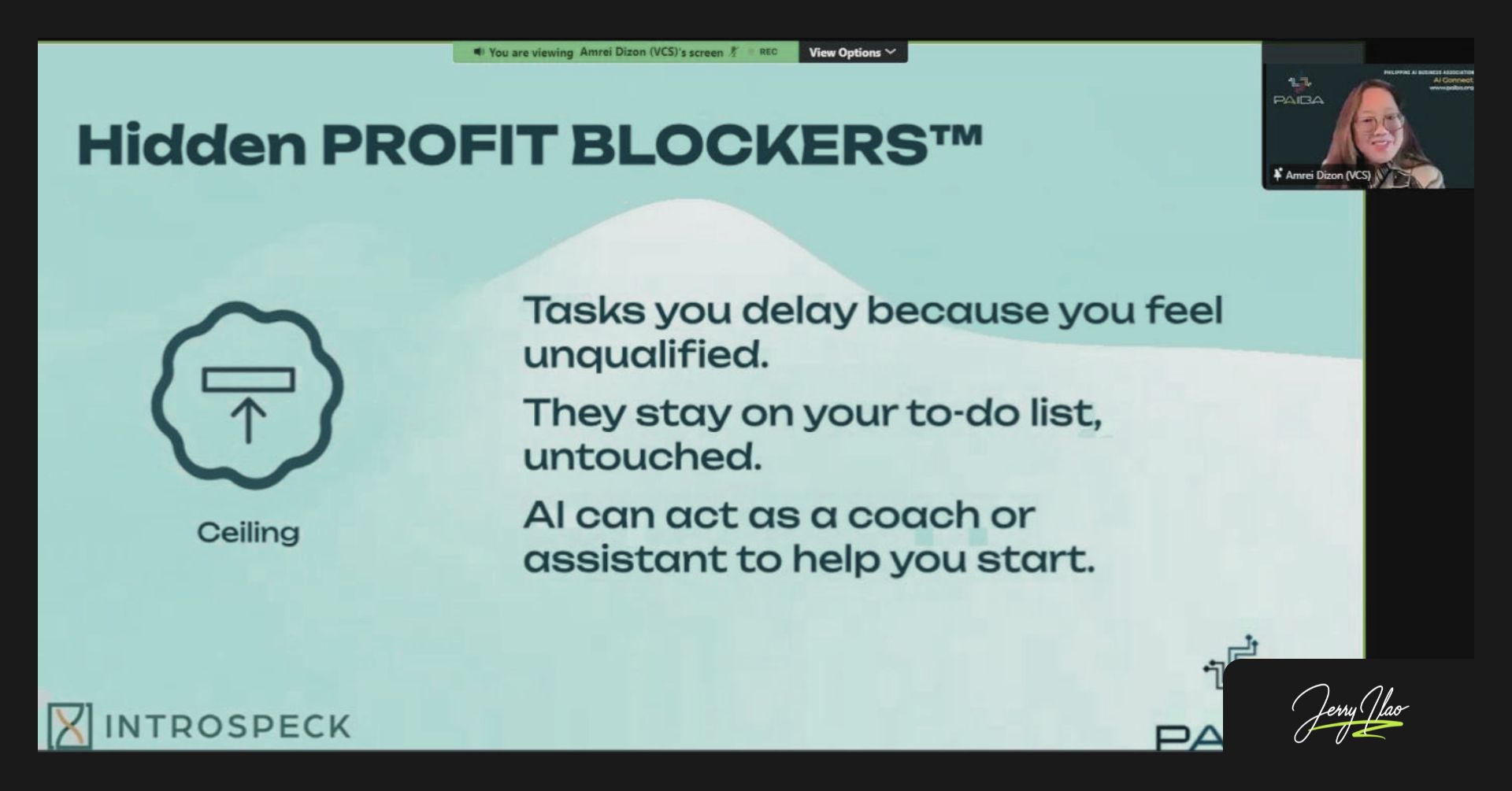

The Hidden Profit Blockers™ framework, developed by Amrei Dizon of Introspeck Management Consultancy and first presented to PAIBA (Philippine AI Business Association), identifies three types of work that block profit in small and medium businesses: Echo (repetitive tasks), Ceiling (tasks you delay), and Fog (overwhelming, unstructured work). AI addresses each type differently — automating Echo, coaching through Ceiling, and clarifying Fog — making it a strategic business partner, not just a productivity shortcut.
Something I’m starting to observe among Filipino business owners who are getting real results from AI: they didn’t start by finding the best tool. They started by looking honestly at their own work.
That shift is harder than it sounds. Most of us default to thinking about AI as a capability question — what can it do? The more useful question is: where in my business is time and energy quietly leaking away?
Amrei Dizon, Co-Founder of Introspeck Management Consultancy, Founding Director of PAIBA, and a Certified Professional Marketer with over 20 years in marketing strategy and business consultancy, built the Hidden Profit Blockers™ framework to answer exactly that question. It was first presented at a PAIBA session, and it has since become the foundation of Introspeck’s Prompt to Profit™ consulting approach for SMEs.
The framework doesn’t start with AI. It starts with a diagnostic.
The three types of work that drain your business without you noticing
Before you can use AI well, you need to see what you’re actually spending your time on. Most business owners, when they sit down and really look, find that their week is full of three types of work they never consciously chose to keep doing.
Echo work: the repetitive tasks you do on autopilot
Echo work is low-value, repetitive work you do over and over, often without questioning whether you should be the one doing it. Rewriting similar emails. Formatting the same type of report. Drafting responses to inquiries that come in the same pattern every week. Updating the same spreadsheet.
These tasks feel productive because something gets finished. But they don’t move the business forward. They just maintain it. And every hour spent on Echo work is an hour not spent on strategy, relationships, or growth.
The problem is not that these tasks exist. Every business has them. The problem is that most business owners absorb them personally because they’re fast and familiar, and handing them off feels like more work than just doing them.
Ceiling work: the tasks you keep postponing
Ceiling work is the category most business owners recognize immediately but rarely admit out loud. These are tasks you know need to get done, but you keep delaying because you feel unsure about how to do them well.
The proposal you haven’t sent because you’re not confident in the pricing. The strategic plan you’ve started three times. The investor brief that keeps getting bumped to next week. The hiring decision you’ve been sitting on because you don’t know where to begin writing the job description.
Ceiling work doesn’t feel like avoidance. It feels like waiting for the right moment, or for more clarity, or for a quieter week. But the right moment usually doesn’t arrive. The task stays stuck, and the opportunity cost compounds quietly.
Fog work: the tasks that feel overwhelming before you start
Fog work is the hardest category to address because it doesn’t have a clear shape. These are the tasks that are unstructured, ambiguous, or complex enough that the first step isn’t obvious. You know something needs to happen, but you don’t know where to begin — so you don’t.
A business owner I work with at PAIBA workshops described it this way: “I know I need to rethink our pricing model, but every time I open a blank document to start, I close it ten minutes later. I don’t even know what the first question is.”
That’s Fog. And it’s not a discipline problem. It’s a structure problem.
How AI addresses each type of work differently
This is where the Hidden Profit Blockers™ framework becomes practical. It doesn’t treat AI as a general productivity tool. It places AI at the specific point in the work where the drain is happening.
For Echo work, AI automates. Repetitive, predictable tasks are where AI delivers the most immediate return. When you stop personally executing Echo work, you free up hours every week for work only you can do. In Introspeck’s consulting work with SMEs, the most common starting point is email management and content reformatting — two categories where even basic AI workflows cut manual time by half in the first week.
For Ceiling work, AI coaches. When the blocker is uncertainty or lack of confidence, AI removes the starting friction. You don’t need AI to make the decision — you need it to give you something to react to. Ask it to draft the first outline of the proposal. Ask it to generate a structure for the strategic plan. Ask it to write three possible options for the job description. You review and revise; AI removes the blank page. Most Ceiling tasks disappear once there’s a starting point.
For Fog work, AI clarifies. When a task feels overwhelming, the problem is usually that it’s too large and unstructured to begin. AI can help break it down. Describe the situation. Describe what you know and what you don’t. Ask it to identify the first three actions. The fog doesn’t disappear — but once you can see the first step, the paralysis does.
And that is still worth paying attention to. The value of AI is not only that things get faster. It’s that some things become possible that weren’t before — not because the work got easier, but because the starting friction got removed.
Why treating AI as a tool misses the point
Most business owners who have tried AI and stopped using it made the same mistake: they treated it like a search engine or a faster way to complete a task they already knew how to do. They gave it vague instructions, got generic output, and concluded it wasn’t useful.
The issue was never the tool.
What the Hidden Profit Blockers™ framework surfaces is that AI works best when it’s deployed at a specific problem, with context, in a deliberate workflow. “Write me a proposal” produces mediocre output. “I’m a management consultant working with a food manufacturing company that wants to improve their supplier payment process. Here is what I know about their current situation. Draft the executive summary section of a consulting proposal that leads with this problem” — that produces something worth editing.
The shift from tool to partner is a shift in how you use it: with context, with intent, and with a clear understanding of where in your work the friction actually lives.
In PAIBA’s AI Connect sessions, this is one of the first patterns Amrei Dizon surfaces with business owners who say AI hasn’t delivered results. Almost always, the prompt is too generic. The context is missing. And the owner hasn’t yet mapped which of their three types of work they’re trying to address.
Four ways to start using AI as a business partner this week
Audit your week for Echo work first. Before you open any AI tool, spend 15 minutes listing the tasks you repeated most this week. Be specific — not “admin” but “reformatting supplier quotes into our standard template.” Pick the most time-consuming item on that list and try giving it to AI tomorrow. Don’t start with your most important challenge. Start with the one that frees up the most time.
Name your Ceiling tasks and give them a starting point. Write down two or three tasks you have been delaying. For each one, open a conversation with AI and ask it to give you a structure to react to. Tell it who you are, what the task is, and what you already know. Review the output and improve it. You’re not outsourcing the decision — you’re removing the blank page.
Break Fog work into its first three steps. When a task feels overwhelming, don’t try to complete it. Try to define it. Open AI, describe the situation in plain language, and ask: “What are the first three things I need to do to move this forward?” Act on the first step only. Return to AI when you need the next one.
Give AI context every time. This is the single most common reason AI underperforms for business owners: they ask without context. Before you type a request, tell AI who you are, what you’re trying to accomplish, who the audience is, and what constraints you’re working within. The more context you provide, the more specific and useful the output. Treat it like briefing a new team member — not issuing a command to a machine.
What this means for Filipino business owners right now
This is the right time to learn how to use AI in business — not because it’s a trend, but because the gap between businesses that use it well and those that don’t is already starting to show up in real outcomes.
The business owners I see moving fastest are not the ones with the most tools. They’re the ones who have been honest about where their time goes, and deliberate about where AI belongs. They’re treating it like a partner in the work, not a shortcut past it.
Filipino professionals have always found ways to compete with resourcefulness, relationships, and deep knowledge of their customers. AI doesn’t replace any of that. What it does is remove the hours that used to go to Echo, Ceiling, and Fog work — and redirect them toward the work that actually requires those strengths.
That’s the real opportunity right now. Not AI adoption as a checkbox. AI integration as a business decision.
I’m excited for what’s ahead as more Filipino professionals learn to think and work smarter with AI — starting not with the tools, but with a clear look at the work itself.
Frequently Asked Questions
What is the Hidden Profit Blockers™ framework? The Hidden Profit Blockers™ framework is a business diagnostic tool developed by Amrei Dizon of Introspeck Management Consultancy. It identifies three categories of work that quietly drain business profit: Echo (repetitive, low-value tasks), Ceiling (tasks delayed due to uncertainty), and Fog (overwhelming, unstructured tasks). The framework was first presented to PAIBA and forms the foundation of Introspeck’s Prompt to Profit™ consulting approach.
How does AI help with repetitive business tasks? AI automates repetitive, predictable work — what the Hidden Profit Blockers™ framework calls Echo work. Examples include reformatting documents, drafting routine emails, and generating first drafts of recurring reports. When business owners offload Echo work to AI, they free up time for strategic decisions, client relationships, and growth activities that require human judgment.
What is the difference between using AI as a tool versus a business partner? Using AI as a tool means asking it to complete isolated tasks without context. Using AI as a business partner means giving it your situation, your constraints, and your goals — and using its output as a starting point to refine. The difference shows up in output quality: generic prompts produce generic results, while context-rich prompts produce something worth editing and acting on.
How do Filipino SMEs typically start with AI adoption? Based on PAIBA workshops and Introspeck’s consulting work with Philippine SMEs, the most effective starting point is identifying one high-frequency Echo task — a repetitive activity the business owner personally handles — and building a simple AI workflow around it. Starting with the most complex challenge leads to frustration. Starting with the most time-consuming repetitive task delivers early wins that build confidence for broader adoption.
What is PAIBA, and why does it matter for AI adoption in the Philippines? PAIBA (Philippine AI Business Association) is a business-led organization dedicated to making AI adoption accessible and practical for Philippine businesses, particularly SMEs. Its founding board, which includes Amrei Dizon as Founding Director, brings together expertise in business development, AI technology, data governance, and industry development. PAIBA runs AI Connect sessions, workshops, and strategic partnerships to ground AI adoption in real business outcomes rather than hype.
Why do many business owners feel AI hasn’t worked for them? The most common reason is prompt quality, not tool quality. Business owners who give AI vague instructions — “write me a proposal,” “summarize this” — receive generic output and conclude the tool isn’t useful. The actual gap is context. AI performs best when given a clear role, a specific task, and enough background information to produce targeted output. The Hidden Profit Blockers™ framework helps address this by first mapping where in the business AI should be applied, before choosing how to use it.
What’s one task in your business that fits Echo, Ceiling, or Fog? I’d be curious where you’re starting.